
Quick Answer
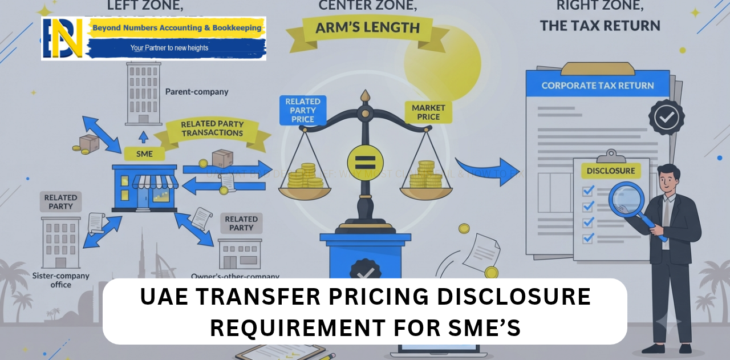
UAE corporate tax law requires every taxable person to disclose related-party transactions in their corporate tax return, regardless of company size. A full transfer pricing Local File is only required when total related-party transactions exceed AED 40 million in a tax period, or when any single category of transaction exceeds AED 4 million. But the disclosure obligation — completing the Related Party Transactions Schedule in EmaraTax — applies to every business with any intercompany or connected-person transaction, no matter how small. Most UAE SMEs are filing their corporate tax returns without completing this schedule, believing transfer pricing rules only apply to large groups. That belief is incorrect and creates a silent compliance gap.
Transfer pricing is one of those terms that makes UAE small business owners switch off.
It sounds like a topic for Big Four accountants working on a multinational’s internal restructuring. Something that happens in boardrooms in London and Singapore, not in a Dubai trading company with two shareholders and a sister company in Abu Dhabi.
Here is the problem with that assumption: UAE transfer pricing law does not make a size exception for the disclosure obligation.
Every UAE business that has any financial or commercial transaction with a related party — a parent company, a subsidiary, a sister company, a shareholder, or even a spouse who is also a supplier — must disclose that transaction in its corporate tax return. Not file a 300-page Local File. Not submit a formal benchmarking study. Just disclose. Fill in the schedule. Identify the transaction type, the counterparty, the amount, and the basis on which the price was set.
Most UAE SMEs are skipping this entirely. And unlike a missed deduction that simply costs money, an incomplete related-party disclosure is a reporting failure that attracts penalties independent of any tax owed.
What are UAE Transfer Pricing Rules and Who do They Actually Apply to?
Transfer pricing rules exist to prevent related parties from setting artificial prices on transactions between themselves in order to shift profit from a high-tax entity to a low-tax entity. In the UAE context, the rules are set out in Articles 34 and 35 of Federal Decree-Law No. 47 of 2022 (the Corporate Tax Law), and they apply the arm’s length principle: transactions between related parties must be priced as if they were conducted between independent parties at market value.
The arm’s length principle applies to every related-party transaction, regardless of the amounts involved and regardless of whether both parties are in the UAE or in different jurisdictions.
What varies by size is the documentation requirement, not the obligation itself.
Businesses whose total related-party transactions exceed AED 40 million in a tax period, or where any single category of transaction exceeds AED 4 million, are required to maintain a formal Local File — a detailed transfer pricing documentation package that includes a functional analysis, economic analysis, and benchmarking study supporting the prices used.
Businesses below those thresholds do not need a Local File. But they still need to complete the Related Party Transactions Schedule in their corporate tax return and they still must be able to demonstrate, if asked, that the prices used in related-party transactions were at arm’s length.
The AED 40 million threshold is widely understood as the point at which transfer pricing becomes relevant. This is incorrect. It is the point at which formal Local File documentation becomes required. The arm’s length obligation and the disclosure obligation exist below that threshold too.
Who is a Related Party Under UAE Corporate Tax Law?
Understanding who counts as a related party is the starting point for knowing whether the disclosure obligation applies to a business.
Under the Corporate Tax Law, a related party includes any person who has a 50% or more ownership interest in the taxable person, any person in whom the taxable person has a 50% or more ownership interest, any two persons both of whom are owned 50% or more by the same third person, any natural person related within the fourth degree of kinship or marriage to the taxable person or to a person with a controlling interest, and any partner in an unincorporated partnership.
In practice this means the following transactions are related-party transactions that require disclosure.
A Dubai LLC that pays a management fee to a holding company in which the same person holds 100% of the shares. A trading company that buys goods from a supplier owned by the same family group. A service company that pays rent to a property company owned by the same shareholder. A business that pays a salary to the owner’s spouse. A UAE subsidiary that makes an intercompany loan to or from its parent. A free zone company that provides services to a mainland company under common ownership.
None of these require a multinational structure. All of them are common in UAE SME and family business contexts. And all of them trigger the disclosure obligation in the corporate tax return.
What does the Disclosure Obligation Actually Require?
The Related Party Transactions Schedule in the EmaraTax corporate tax return asks for the following information for each category of related-party transaction.
The name of the related party and their Tax Registration Number if they are a UAE taxable person. The nature of the relationship between the two parties. The category of transaction, such as sale of goods, provision of services, transfer of assets, intercompany loan, management fee, rent, or royalty. The total value of the transactions in that category during the tax period. The transfer pricing method used to determine that the price was at arm’s length, such as the Comparable Uncontrolled Price method, Cost Plus method, or Transactional Net Margin Method. A confirmation that the transactions were priced on an arm’s length basis.
This disclosure is not a full benchmarking study. It does not require a report. It requires the business to have thought about whether its related-party transactions were at market prices, and to state on the return how it reached that conclusion.
The issue for most UAE SMEs is not that the disclosure is technically difficult. It is that most businesses have never formally considered whether their intercompany transactions are at arm’s length at all. A management fee charged between sister companies was set years ago at a convenient round number. A rental charge from a property-owning holding company to an operating subsidiary was set based on what felt fair between family members, not based on market evidence. An intercompany loan has a zero interest rate because it was simpler.
Each of these requires a defensible answer to the question: is this price what an independent third party would have agreed to? And each requires that answer to be stated on the corporate tax return.
The Three Most Common Related-Party Transaction Gaps in UAE SMEs
Based on the patterns that emerge when UAE SME corporate tax returns are prepared correctly for the first time, three categories of related-party transaction are most consistently undisclosed or mispriced:
- Management fees between group companies: Many UAE family businesses and SME groups charge a management fee from one entity to another to centralise overhead costs. These fees are frequently set at a round number based on internal convenience rather than a benchmarked rate. If the FTA asks what analysis supports the fee amount, there is often no documented answer. The correct approach is to calculate the management fee based on the actual costs incurred to provide the management services, plus an arm’s length markup, and to document that calculation.
- Owner salary above market rate: As covered in the separate Beyond Numbers guide on connected person salary, the salary paid to an owner-employee must be benchmarked against what an unrelated person in the same role would be paid. This is a related-party transaction that must be disclosed, and the arm’s length test applies to it. Businesses that have been paying the owner a salary based on what the business could afford rather than what the market pays have a disclosed transaction that may not survive scrutiny.
- Zero-interest or below-market intercompany loans: As covered in the Beyond Numbers guide on intercompany loans, an interest-free loan between related companies creates a deemed interest income at the lending entity level. This is a related-party transaction. It must be disclosed. The interest rate imputed to it must reflect what an independent lender would charge in equivalent circumstances. Many UAE SMEs with intercompany funding arrangements have never applied an arm’s length interest rate to those arrangements at all.
Each of these three categories is common. Each requires disclosure in the corporate tax return. Each requires the business to be able to demonstrate the arm’s length basis for the price used.
The Penalty for not Disclosing
Failing to complete the Related Party Transactions Schedule in the corporate tax return is a reporting failure. The UAE Tax Procedures Law applies administrative penalties for inaccurate or incomplete tax returns.
An understated tax liability resulting from a mispriced related-party transaction is treated as a tax shortfall, which attracts the standard corporate tax underpayment penalties. But the failure to disclose the transaction at all is separately penalised as a failure to maintain and provide required information, with penalties starting at AED 10,000 for a first offence and rising for repeat violations.
The FTA’s EmaraTax system cross-references corporate tax returns against VAT returns and against related-party data it holds for other group members. An intercompany management fee that appears as income in one entity’s VAT return but is not disclosed as a related-party transaction in the paying entity’s corporate tax return creates a flag that the system is specifically designed to catch.
Disclosure is not optional. It is not a large-company obligation. It applies to every UAE corporate tax registrant with any related-party transaction in the period.
6-Question Related-party Disclosure Check for UAE Businesses
Work through this before filing any corporate tax return:
- Does the business have any transaction with a shareholder, a company under common ownership, or a family member of a controlling shareholder?
- Has every such transaction been listed in the Related Party Transactions Schedule in the EmaraTax return?
- For each transaction, can the business state which transfer pricing method was used and why the price was at arm’s length?
- For management fees between group entities, is the fee based on documented costs and a market markup rather than a convenient round number?
- For any intercompany loan, has an arm’s length interest rate been applied and been disclosed?
- For any salary paid to an owner or family member, has a market benchmarking analysis been completed and retained?
A confident yes to all six means the related-party disclosure position is sound. Any uncertain answer should be resolved before the return is filed.
Frequently Asked Questions
Q. Does a UAE sole establishment with no group companies have related-party transactions?
A. Possibly yes. A sole establishment whose owner also works in the business and draws a salary has a connected-person transaction that is subject to the arm’s length principle. If the owner rents premises from a company they also own, that rent is a related-party transaction. If the owner’s spouse provides services to the business, that is a related-party transaction. The absence of a formal group structure does not eliminate related-party exposure.
Q. What is the AED 4 million threshold?
A. The AED 4 million per-category threshold triggers the Local File requirement for a specific category of transaction. If total related-party sales of goods exceed AED 4 million in the period, a Local File covering that category of transaction is required. This threshold applies per category, not to total related-party transactions. Total related-party transactions above AED 40 million trigger a Local File across all categories.
Q. Is a Local File the same as a benchmarking study?
A. A Local File includes a benchmarking study as one component, but it is a broader document. It includes a description of the business and its group structure, a functional analysis of the transactions, and an economic analysis benchmarking the prices against comparable independent transactions. For businesses below the AED 40 million threshold, a full Local File is not required, but contemporaneous documentation supporting the arm’s length basis of each transaction should still be maintained.
Q. What transfer pricing methods are accepted by the FTA?
A. The FTA accepts the methods recognised by the OECD Transfer Pricing Guidelines: Comparable Uncontrolled Price (CUP), Cost Plus, Resale Price, Transactional Net Margin Method (TNMM), and Profit Split. The most appropriate method depends on the nature of the transaction. For simple services, Cost Plus or TNMM is most commonly used. For goods, CUP is preferred where comparable data is available.
Q. If both parties to a related-party transaction are UAE companies paying 9% corporate tax, does the arm’s length test still matter?
A. Yes. Even when both parties are subject to the same UAE corporate tax rate, the FTA still requires related-party transactions to be priced at arm’s length and disclosed. The concern is not only cross-border profit shifting but also the accuracy of the tax computation in each individual entity. An entity that overpays a related party reduces its own taxable profit without a corresponding taxable income at the recipient that would otherwise be at the same rate.
You do not have to Navigate This Alone
Most UAE SMEs and family businesses entered the corporate tax era with their intercompany arrangements already in place, priced by convenience rather than by any formal arm’s length analysis. The structure worked when there was no corporate tax. It needs to be revisited now that there is.
That is exactly where Beyond Numbers comes in.
Beyond Numbers helps UAE businesses map every related-party transaction across their group, assess each one against the arm’s length standard, prepare the supporting documentation, and complete the Related Party Transactions Schedule in the corporate tax return correctly. For businesses approaching the AED 40 million threshold, the team also prepares the full Local File and Master File documentation required to satisfy the FTA.
If your business has intercompany transactions of any kind and your corporate tax return has never included a completed Related Party Transactions Schedule, that is a gap that needs to be fixed before the next return is filed.
Talk to Beyond Numbers today. Our team will assess your related-party transaction structure, identify any arm’s length pricing gaps, and make sure your disclosure is complete and defensible.
This article reflects UAE Corporate Tax rules as of November 2026 and is for general guidance only. For advice specific to your business, speak with the Beyond Numbers tax team directly.