
Quick Answer
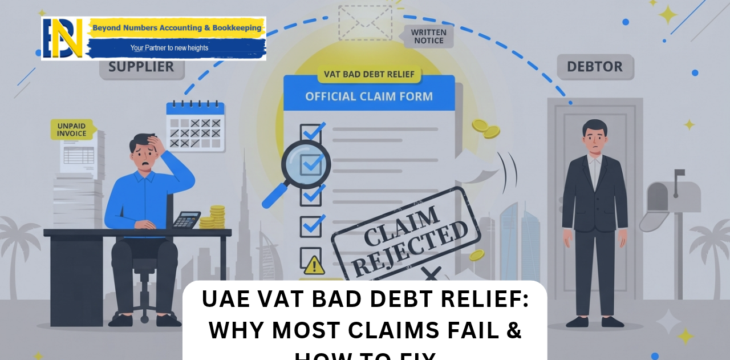
UAE businesses can reclaim output VAT already paid to the FTA on invoices that remain unpaid after six months, under Article 64 of the UAE VAT Law. However, the relief requires satisfying six specific conditions simultaneously. The condition that most businesses fail is the written notification requirement: the supplier must formally notify the debtor in writing that VAT has been adjusted on the unpaid invoice. Without that written notification, completed in the correct format and provably sent, the entire bad debt relief claim is invalid regardless of whether the other five conditions are met. Most businesses either never send the notification or send something informal that the FTA does not accept as sufficient.
You have already paid the VAT on the invoice. That money left your account and went to the FTA.
Your customer never paid you. They stretched the payment, went quiet, changed contact details, or simply refused to settle the account.
Six months have passed. Under UAE VAT law, you have a legal right to reclaim the VAT you paid on that invoice. The rule exists. It is in the law. It is designed exactly for this situation.
So why do most UAE businesses either never claim it, or claim it and get rejected?
The answer almost always comes down to one specific step that most businesses skip, do it wrong, or do it too late: the written notification to the debtor.
This post goes deeper than the overview guide. It explains exactly what the written notification must contain, when it must be sent, how it must be sent to satisfy the FTA, and what documentation you need to hold on to after sending it. If you have already tried to claim bad debt relief and been rejected, this is almost certainly where the claim failed.
A Quick Recap: The Six Conditions for UAE VAT Bad Debt Relief
Before focusing on the notification requirement, it helps to understand that bad debt relief under Article 64 of the UAE VAT Law requires all 6 conditions to be met simultaneously. Missing any one of them disqualifies the entire claim for that invoice:
- Condition 1. The supply must have been made to a registered VAT person. The debtor must have been VAT-registered at the time of the supply.
- Condition 2. The output VAT on the supply must already have been paid to the FTA. You cannot claim bad debt relief on VAT you have not yet paid. The payment must have been made in an earlier VAT return period.
- Condition 3. The debt must have remained unpaid for a minimum of six months from the date of supply. The clock runs from the date the supply was made, not from the invoice due date.
- Condition 4. The debt must have been written off in the creditor’s books of account. A formal bad debt write-off in the accounting records is required, not simply a note that payment is overdue.
- Condition 5. The creditor must have notified the debtor in writing that the VAT has been adjusted. This is the written notification requirement.
- Condition 6. The creditor must retain evidence of all of the above. Documentation must be kept for the standard seven-year retention period.
Five of these six conditions are well understood by most UAE businesses. Condition 5 is where the majority of claims break down.
Why Condition 5 — The Written Notification — is Where Claims Fail
The written notification requirement exists because the UAE VAT system is designed symmetrically. When a supplier reclaims output VAT through bad debt relief, the FTA expects the debtor to simultaneously reduce their input tax credit for the same amount. The written notification is the mechanism by which the debtor is informed of this obligation.
This symmetry is important. The FTA is not simply allowing the supplier to get money back. It is adjusting both sides of the same transaction. The debtor must reduce their input VAT by exactly the amount the supplier recovers. Without the written notification, the FTA cannot be confident that the debtor has been properly informed and has made or will make the corresponding adjustment.
What this means in practice is that the written notification is not a formality. It is a substantive condition that must be met with evidence. And the FTA’s standard for evidence is higher than most businesses initially assume.
What Must the Written Notification Contain?
The UAE FTA’s guidance on bad debt relief, confirmed in Public Clarification VATPG0005, sets out what the written notification to the debtor must contain to be accepted as satisfying Condition 5.
The notification must identify the original invoice or invoices by invoice number, invoice date, and the total amount including VAT. It must state the amount of VAT that has been adjusted. It must inform the debtor that the debtor is required to make a corresponding adjustment to their own input tax credit for the same amount in their next VAT return. It must reference the VAT registration number of the supplier. It must be clearly dated.
The notification does not need to be a legal letter. It does not need to come from a lawyer. But it does need to contain all of the above elements. An informal email that says “we have written off your unpaid invoice” does not satisfy the requirement if it does not specifically mention the VAT amount adjusted and the debtor’s corresponding obligation.
How the Notification Must be Sent
The notification must be sent in writing. The FTA has accepted written notifications sent by email, by physical letter, and by formal legal notice. The key requirement is not the channel but the evidence of delivery.
What the FTA looks for when reviewing a bad debt relief claim is proof that the notification was actually sent and received by the debtor, or at minimum proof that the supplier made genuine attempts to deliver it. A notification that was drafted but never sent is not a notification. A notification sent to an outdated email address the supplier knew was no longer active is not a compliant notification.
The minimum evidence of sending that the FTA expects is a sent email from the supplier’s business email account to the debtor’s last known email address, with the notification attached or included in the body, retained with its sent timestamp. For higher-value claims or for debtors with disputed contact details, a physical letter sent by registered or tracked mail provides stronger evidence. For debtors who have become uncontactable, a formal legal notice from a law firm creates a contemporaneous record that the supplier made all reasonable attempts to notify.
The notification must be sent before the bad debt relief claim is made in the VAT return. It cannot be backdated or prepared retrospectively after the claim has been submitted. The sequence is: send the notification, then make the claim.
Timing: When Must the Notifications be Sent?
The UAE VAT Law requires the notification to be sent at or around the time the bad debt is written off in the books of account and the relief is claimed. It must be sent before the relief is claimed.
In practice this means the following sequence applies to every bad debt relief claim.
Month seven after the supply date. The debt has been outstanding for six months since the supply was made. The first condition on timing is met.
Write off the debt. Record a formal bad debt write-off journal entry in the accounting system, referencing the specific invoice being written off. This satisfies Condition 4.
Send the written notification. Prepare and send the written notification to the debtor containing all required elements. Retain evidence of sending. This satisfies Condition 5.
Claim the relief in the next VAT return. In the VAT return for the period in which the write-off occurred and the notification was sent, reduce the output VAT by the amount of VAT on the written-off invoice. This is recorded as an adjustment in Box 4 (Adjustment to output VAT) of the VAT return.
Retain all documentation. Keep the original invoice, the payment records showing no payment was received, the write-off journal entry, the written notification with evidence of sending, and the VAT return in which the adjustment was claimed. All of this must be retained for seven years.
If the notification is sent after the relief has been claimed in the return, the claim is technically non-compliant. The notification must precede or coincide with the adjustment in the return.
What Happens If the Debtor is VAT-Deregistered OR Uncontactable?
This is a question that comes up frequently and the FTA’s position is nuanced.
If the debtor has deregistered for VAT since the supply was made, Condition 1 (the debtor must have been VAT-registered at the time of the supply) is still met, because the registration requirement applies at the time of the original supply, not at the time the relief is claimed. However, the written notification requirement still applies. The notification should be sent to the debtor’s last known address. The supplier should retain evidence of the attempt to send.
If the debtor is genuinely uncontactable because they have ceased to exist, have dissolved their company, or have disappeared, the supplier should retain evidence of the attempts made to contact them: copies of emails to the last known address, copies of registered letters returned undelivered, and any other documentation that shows the supplier made genuine, documented efforts to deliver the notification.
The FTA’s position is that the notification requirement cannot simply be waived because the debtor is hard to find. But it can be satisfied by documented genuine attempts where the debtor is genuinely uncontactable.
A Worked Example of the Full Sequence Done Correctly
A Dubai-based supplier invoiced a client on 1 March 2025 for AED 105,000, which included AED 5,000 in VAT at 5%. The supplier filed their Q1 2025 VAT return and paid the AED 5,000 output VAT to the FTA.
By 1 September 2025, six months have passed since the supply date. The client has not paid. The supplier decides to write off the debt.
On 2 September 2025, the supplier records a bad debt write-off in their accounting system for the full AED 105,000, referencing invoice number INV-2025-0147.
On the same day, the supplier sends the following written notification to the debtor by email.
“Dear [Client name], We write to inform you that invoice INV-2025-0147 dated 1 March 2025 for AED 105,000 (inclusive of VAT of AED 5,000) has been written off as a bad debt in our accounts. As required under UAE VAT law, we are notifying you that we have adjusted our output VAT by AED 5,000 in connection with this invoice. You are required to make a corresponding adjustment to reduce your input tax credit by AED 5,000 in your next VAT return. Our VAT registration number is [TRN]. Please contact us if you have any questions. Regards, [Name].”
The supplier retains the sent email with its timestamp.
In the Q3 2025 VAT return, the supplier records a Box 4 adjustment reducing output VAT by AED 5,000.
The supplier files a folder containing: the original invoice, payment records showing no payment, the write-off journal entry, the sent notification email, and a copy of the Q3 2025 VAT return. This folder is retained for seven years.
This sequence satisfies all six conditions. The claim is valid.
6-Questions Bad Debt Relief Readiness Check
Work through this for every invoice you are considering claiming bad debt relief on.
1. Was the debtor VAT-registered at the time of the original supply?
2. Has the output VAT on this invoice already been paid to the FTA in a previous return?
3. Have at least six months passed since the date of the original supply?
4. Has the debt been formally written off in the accounting records with a dated journal entry referencing the specific invoice?
5. Has the written notification been sent to the debtor, containing the invoice reference, the VAT amount adjusted, and the debtor’s obligation to reduce their input tax, and has the evidence of sending been retained?
6. Is all supporting documentation retained and accessible for a potential FTA review?
A yes to all six means the claim is properly supported. A no on condition 5 means the claim is not yet valid and the notification must be sent before the return is filed.
Frequently Asked Questions
Q. Can bad debt relief be claimed on invoices that were raised before VAT was introduced in the UAE in January 2018?
A. No. Bad debt relief under Article 64 applies only to supplies made after VAT was introduced. It cannot be applied to pre-2018 debts.
Q. Is there a minimum amount threshold for making a bad debt relief claim?
A. No. There is no minimum VAT amount that must be involved for a claim to be valid. However, businesses should consider the administrative effort relative to the amount recoverable.
Q. What happens if the debtor does eventually pay after bad debt relief has been claimed?
A. If the debtor pays the full amount or any portion of the debt after bad debt relief has been claimed, the supplier must pay back the corresponding VAT to the FTA. The repayment must be declared as an output VAT increase in the VAT return for the period in which the payment was received. The debtor correspondingly recovers the input tax credit they had previously reduced.
Q. Does a supplier need to pursue legal action before claiming bad debt relief?
A. No. The UAE VAT Law does not require legal action or a court judgment as a condition for bad debt relief. The six-month period from the date of supply is the trigger, not the outcome of any legal process.
Q. Can bad debt relief be claimed for partial payments?
A. Yes. If the debtor has paid part of the invoice but not the full amount, bad debt relief can be claimed on the VAT attributable to the unpaid portion only. The written notification should specify the remaining unpaid balance and the VAT attributable to it.
Go Further Than the Overview
If you read Beyond Numbers‘ earlier guide on UAE VAT bad debt relief and wondered about the practical mechanics of actually making a claim, this post has covered the detail most businesses need.
That said, applying bad debt relief correctly to a real portfolio of unpaid invoices, some of which may have partial payments, some of which involve debtors who have deregistered, and some of which may have invoices stretching back close to the limitation period, requires careful case-by-case analysis.
That is exactly where Beyond Numbers comes in.
Beyond Numbers helps UAE businesses review their outstanding debtor ledger, identify every invoice eligible for bad debt relief, prepare the correct written notifications, record the write-off entries, and claim the adjustment in the right VAT return period. The team also ensures all documentation is retained in a form that will satisfy FTA scrutiny if a review occurs.
If you are carrying overdue invoices on which you have already paid VAT to the FTA, you may be sitting on a legitimate refund you have never claimed. The conditions are specific. The process is manageable. But it has to be done correctly.
Talk to Beyond Numbers today. Our team will assess your unpaid invoice position, calculate the VAT recoverable, and handle the full bad debt relief process from notification to return adjustment.
This article reflects UAE VAT rules as of November 2026 and is for general guidance only. For advice specific to your business, speak with the Beyond Numbers tax team directly.