
QUICK ANSWER
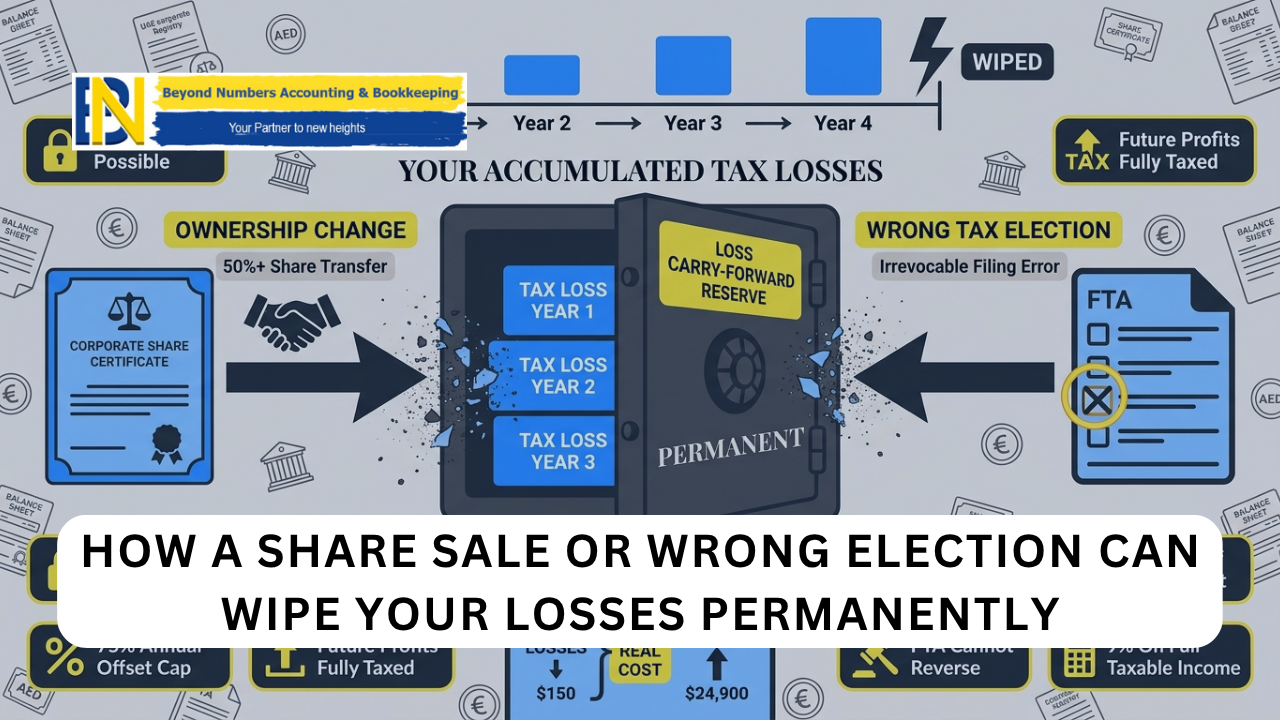
Under the UAE Corporate Tax Law, tax losses can be carried forward indefinitely and used to reduce taxable income in future years, but only up to 75% of taxable income in any one period. Two traps can permanently destroy these accumulated losses. First, if more than 50% of a company’s ownership changes and the business also changes its activities, the carried-forward losses are forfeited completely. Second, in any period where a business elects Small Business Relief, it cannot generate new losses for carry-forward and cannot use existing losses — those losses are frozen and unavailable for that period. A business that elects Small Business Relief in a profitable year when it has carried-forward losses from a prior period permanently gives up the chance to use those losses against that year’s income.
Your business had a tough year in 2024. You spent heavily on setup costs, a new system, staff you had to let go when the revenue did not come in as fast as expected. The year closed with a tax loss of AED 320,000.
That loss is not gone. Under UAE Corporate Tax Law, it carries forward. It sits in the accounts as a future tax credit, waiting for the year your business becomes profitable and reducing the tax you owe.
In 2025, the business turned around. Revenue grew. You started to see real profit. And you brought in a new investor who took a 55% stake to fund the next stage of growth.
The money arrived. The partnership was signed. The future looked bright.
What nobody checked, before the share transfer completed, was what that 55% ownership change did to your AED 320,000 in carried-forward losses.
The answer is that it potentially wiped them out. Permanently. Not reduced. Not frozen. Gone.
This is the UAE corporate tax loss carry-forward ownership change trap. It is the most financially damaging and least talked-about corporate tax risk for UAE businesses that are growing, restructuring, or raising capital right now. And the window to protect those losses closes the moment the share transfer completes.
WHAT IS THE UAE CORPORATE TAX LOSS CARRY-FORWARD RULE?
Under Article 37 of the UAE Corporate Tax Law, Federal Decree-Law No. 47 of 2022, a taxable person that incurs a tax loss in one tax period can carry that loss forward to future tax periods and use it to reduce taxable income. There is no time limit. The loss does not expire after a fixed number of years. It remains available until it is fully utilised, as long as the conditions for its use continue to be met.
The 75% annual utilisation cap is the well-known part of this rule. In any tax period where carried-forward losses are being used, the amount of taxable income that can be offset by those losses is capped at 75%. The remaining 25% of taxable income is always taxable at the applicable rate, regardless of how large the accumulated loss pool is.
This cap is not optional. A business that has AED 1 million in taxable income and AED 2 million in carried-forward losses must apply AED 750,000 of losses against that income. It cannot choose to apply less in order to preserve a larger balance. The FTA requires the maximum permissible amount to be used in every period.
But the 75% cap is not the part that permanently destroys losses. That is the job of the two traps that almost nobody warns businesses about before it is too late.
TRAP ONE: THE OWNERSHIP CHANGE TEST
Under Article 39 of the UAE Corporate Tax Law, a company’s ability to carry forward and use its tax losses can be permanently forfeited if two conditions are both met simultaneously.
Condition one: more than 50% of the company’s ownership changes. This means that the total combined shareholding of new owners, people who did not own shares before the change, exceeds 50% of the company’s total shares after the transaction completes.
Condition two: the company undergoes a significant change in its business activities within two years before or after the ownership change. A significant change in business activities means the company stops doing what it was doing and starts doing something materially different, or it changes its nature so substantially that the new business is not a continuation of the old one.
Both conditions must be present for the loss forfeiture to apply. A >50% ownership change alone, without a change in business activities, does not automatically forfeit the losses. A change in business activities alone, without the ownership change, also does not forfeit the losses. But when both happen together within the two-year window, the losses accumulated before the ownership change are gone.
This two-year window is the part that catches businesses. An investor who took a 55% stake in 2025 and then pushed the company into a new service line in 2026 could trigger the forfeiture retroactively, applying it to losses that arose in 2024, two years before the activity change.
The test looks at both directions in time. Not just what happened after the ownership change, but what happened in the two years before it as well. A business that changed its activities in 2024 and then sold 60% of its shares to a new investor in 2026 may have triggered the forfeiture at the point of the share sale.
A REAL-WORLD EXAMPLE OF TRAP ONE
Consider a Dubai-based events management company that began corporate tax filing in 2024. The 2024 tax year was difficult. The company incurred a tax loss of AED 480,000, recorded correctly in its corporate tax return and carried forward.
In early 2026, the founder decided to pivot the business toward digital event platforms. The company began offering software-as-a-service tools for virtual events rather than physical event management. Revenue from the old physical events business dropped to below 20% of total revenue within twelve months.
In mid-2026, a technology investor acquired a 60% stake in the company, attracted by the new digital direction.
At this point, both conditions under Article 39 have been met. Ownership changed by more than 50%. Business activities changed significantly, moving from physical events to digital platforms, within the two-year window surrounding the ownership change.
The AED 480,000 in carried-forward losses is forfeited. In the 2026 tax return, those losses cannot be applied against the taxable income of the now-profitable digital business. The company pays 9% on its full taxable profit above AED 375,000, with no offset from the loss pool it accumulated during the transition year.
Had anyone modelled this risk before the share transfer completed, the business had options. The ownership change could have been structured to stay at or below 50%. The two-year lookback period could have been considered when planning the pivot timeline. An alternative structure could have been considered. None of those options were available after the transfer closed.
TRAP TWO: THE SMALL BUSINESS RELIEF ELECTION FREEZES AND CAN FORFEIT LOSSES
This is the trap that catches more businesses by surprise than almost any other corporate tax interaction in 2026.
Small Business Relief allows eligible UAE businesses with revenue below AED 3 million to elect to be treated as having zero taxable income for a tax period. The relief is available for tax periods ending on or before 31 December 2026. It is a genuine and valuable simplification that many businesses have used correctly.
The trap is what happens to carried-forward losses in any period where Small Business Relief is elected.
First, in a period where Small Business Relief is elected, the business is treated as having zero taxable income. This means it cannot use any carried-forward losses from prior periods against that year’s income. The losses are not forfeited in this scenario, but they are frozen and unavailable for that period.
Second, and far more consequentially, in a period where Small Business Relief is elected, the business cannot generate new tax losses for carry-forward. If the business actually incurred a genuine economic loss in that year, that loss simply does not exist for tax purposes because the election treats taxable income as zero. That loss is gone. It will never be carried forward. It cannot be recovered in a future year.
Third, and the scenario that destroys the most value, is a business that has accumulated carried-forward losses from prior periods and then, in a profitable year, elects Small Business Relief because the revenue is still below AED 3 million. By electing SBR in that profitable year, the business chooses to be treated as having zero taxable income. This means it pays no tax that year, which sounds good. But it also means it did not use any of its carried-forward loss pool against that year’s profit. The losses remain in the pool but the chance to deploy them against that year’s income is permanently gone. The AED 375,000 zero-rate band that would have applied anyway makes this decision particularly important to model carefully before electing.
A REAL-WORLD EXAMPLE OF TRAP TWO
Consider a UAE sole-establishment consultancy with a financial year ending 31 December 2025. In 2024, the business had a difficult year and recorded a tax loss of AED 190,000, correctly carried forward.
In 2025, revenue recovered to AED 2.1 million. Taxable profit for the year was AED 410,000. The business is below the AED 3 million SBR threshold and chooses to elect Small Business Relief for 2025 because the owner assumes it is the simpler and cheaper option.
Under SBR, the business is treated as having zero taxable income for 2025. No corporate tax is owed. The owner is satisfied.
But the actual tax calculation, had SBR not been elected, would have looked like this. Taxable income of AED 410,000. Carried-forward losses from 2024 of AED 190,000, limited to 75% of AED 410,000, meaning AED 190,000 is fully within the cap. Taxable income after loss relief: AED 220,000. This is below the AED 375,000 zero-rate threshold. Tax owed: zero.
The outcome is identical. In both scenarios, the 2025 tax liability is zero. But by electing SBR, the business forfeited the right to recognise the use of its AED 190,000 loss pool. Under SBR, the 2025 return shows zero taxable income and the loss remains at AED 190,000. When 2026 brings higher taxable income, the loss is still there to use. In this specific scenario, the choice did not cost the business money.
But consider a variation: the 2025 taxable income was AED 600,000 instead of AED 410,000. In that case, the SBR election saves the business 9% on AED 225,000, which is AED 20,250 in tax. But using the carried-forward loss of AED 190,000 would have reduced taxable income to AED 410,000, meaning tax of only 9% on AED 35,000, which is AED 3,150. Not electing SBR and using the losses instead saves the business an additional AED 17,100 compared to the SBR route, even though SBR appeared to be the free option.
The lesson: always model both scenarios before electing Small Business Relief in any year where carried-forward losses exist.
HOW CAN A UAE BUSINESS PROTECT ITS CARRIED-FORWARD LOSSES?
Protecting tax losses is a matter of planning before transactions happen, not reacting after they close.
Before any share transfer or ownership change, model the ownership arithmetic. Know exactly what percentage of the company the new parties will hold after the transaction and whether the combined new ownership exceeds 50%.
Consider the business continuity test in parallel with the ownership test. If a significant change in business activities has already occurred or is planned within two years of a potential ownership change, take specific tax advice on whether both Article 39 conditions will be met simultaneously.
Do not elect Small Business Relief in a profitable year without first calculating the tax outcome under both scenarios. If the business has carried-forward losses, model what the tax bill would be using those losses against the year’s taxable income before choosing between SBR and standard filing.
If losses were genuinely incurred in a year, do not elect Small Business Relief for that year. The election prevents those losses from being generated for carry-forward purposes, destroying a future tax asset permanently.
Keep detailed records of each tax loss by year. The FTA requires the oldest losses to be used before newer ones, and each loss must be supported by the documentation from the tax period in which it arose, retained for a minimum of seven years.
6-QUESTION CHECK TO PROTECT YOUR CARRIED-FORWARD LOSSES
Work through this before any share transaction, restructuring, or SBR election.
1. Does your business currently have carried-forward tax losses from any prior period?
2. If a share transfer or new investment is being planned, will the combined new ownership after the transaction exceed 50% of the company?
3. Has the business undergone or is it planning a significant change in its activities within the two years before or after any planned ownership change?
4. Before electing Small Business Relief in any year, has the tax outcome under both SBR and standard filing been modelled to confirm which produces the better result?
5. Is there any year in which the business incurred a genuine economic loss but elected Small Business Relief, potentially causing those losses to be permanently forfeited?
6. Are the tax loss records for each prior period retained with full supporting documentation that can be produced for a seven-year period?
A confident yes to all six means the carried-forward loss position is protected and correctly managed. Any uncertain answer is worth investigating before the next significant business transaction or tax filing.
FREQUENTLY ASKED QUESTIONS
Q. Can UAE tax losses be carried back to reduce tax in prior years?
A. No. The UAE Corporate Tax Law does not permit loss carry-back. Losses can only be carried forward to future tax periods. There is no mechanism to reopen a prior year’s return to apply a current-year loss against it.
Q. Do the ownership change and business continuity tests apply to free zone businesses?
A. Free zone businesses with Qualifying Free Zone Person status are generally excluded from the standard loss carry-forward rules, because their qualifying income is taxed at 0% and losses from 0% activities cannot offset 9% taxable income and vice versa. Specific advice is recommended for any free zone entity contemplating an ownership change with historic losses in either ring-fenced category.
Q. If losses are forfeited due to an ownership change, is there any way to recover them?
A. No. Once losses are forfeited under Article 39, they are permanently lost. They cannot be recovered through restructuring, reverse transactions, or any subsequent ownership change.
Q. Can tax losses be transferred between related companies?
A. Yes, under Article 38, a company can transfer its unused tax losses to another company under common ownership, provided both companies have at least 75% common ownership throughout the relevant period, both use the same financial year and accounting standards, and neither is an exempt person or Qualifying Free Zone Person. The transferred losses are subject to the same 75% annual utilisation cap in the receiving company.
Q. What records does the FTA expect for claimed tax losses?
A. The FTA expects a complete record of the tax loss for the period in which it arose, including the corporate tax return, the financial statements supporting the loss, and the complete working paper showing how the loss was calculated. These must be retained for a minimum of seven years from the date of the relevant filing.
YOU DO NOT HAVE TO MANAGE THIS ALONE
For most UAE business owners, the mechanics of tax loss carry-forward, ownership continuity, business continuity, and SBR interactions are not considerations that come up in the normal running of a business. They surface at exactly the wrong moment: when a share sale is closing, when an investor is committing capital, when a year-end election needs to be made under time pressure.
That is exactly where Beyond Numbers comes in.
Beyond Numbers helps UAE businesses track and protect their carried-forward tax loss positions, model the impact of planned ownership changes against the Article 39 two-condition test before transactions complete, run the dual-scenario calculation before any Small Business Relief election in a year where loss carry-forwards exist, and maintain the complete loss records required to support every future utilisation claim.
If your business has accumulated tax losses from any prior period and you are considering a share transfer, new investment, business pivot, or SBR election, the right time to assess the impact on those losses is before the decision is made, not after.
Talk to Beyond Numbers today. Our team will review your current loss position, model any planned transactions against the applicable rules, and make sure your accumulated losses are protected and correctly deployed when the time comes.
This article reflects UAE Corporate Tax rules as of mid-2026 and is for general guidance only. For advice specific to your business, speak with the Beyond Numbers tax team directly.