
Quick Answer
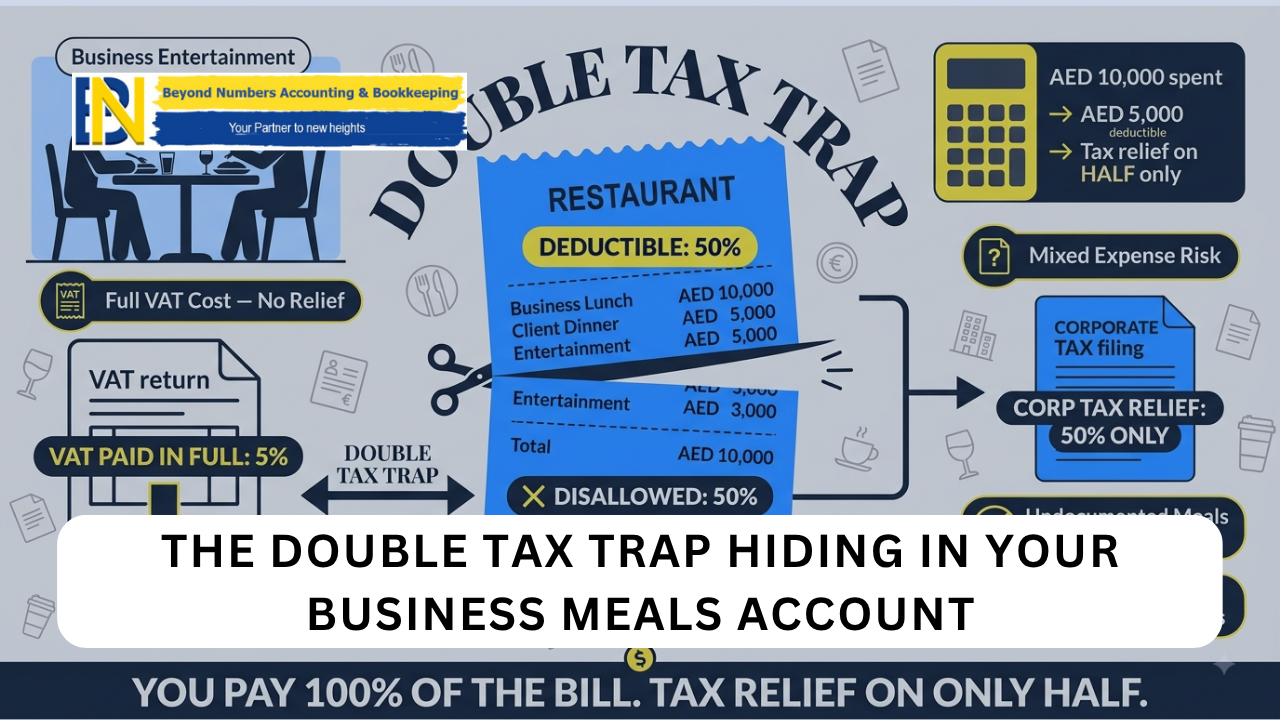
Under Article 32 of the UAE Corporate Tax Law, only 50% of entertainment, amusement, or recreation expenses incurred for clients, suppliers, or business partners is deductible. The remaining 50% is permanently disallowed regardless of how well documented the expense is or how genuine the business purpose. Separately, under UAE VAT Law, input VAT on client entertainment expenses is blocked and cannot be recovered as input tax. A business that takes a client to dinner therefore faces two simultaneous restrictions: half the cost disappears as a corporate tax deduction and the VAT on top of it is completely unrecoverable.
Last quarter you took three clients to dinner. You signed a new supplier deal over lunch. You bought event tickets for a business partner. You hosted a client at a corporate hospitality evening.
You put all of it through the business. Kept every receipt. Every single expense was genuinely for business purposes. You expected to deduct the lot.
Here is what the UAE tax rules actually say about every one of those expenses:
- For corporate tax purposes, you can only deduct half. The other half is permanently disallowed. Not claimable later. Not recoverable through a different mechanism. Gone.
- And the VAT you paid on top of every one of those bills? Also gone. Blocked completely under UAE VAT Law.
Most UAE businesses have no idea this double restriction exists. They are claiming full deductions on entertainment spending, filing corporate tax returns with incorrect deduction positions, and quietly building up a gap the FTA is increasingly finding when it looks at first-time corporate tax filings.
What is the UAE Entertainment Expense 50% Corporate Tax Cap?
The entertainment expense cap comes from Article 32 of the UAE Corporate Tax Law, Federal Decree-Law No. 47 of 2022. It places a specific restriction on the deductibility of entertainment, amusement, and recreation expenditure incurred for the purpose of entertaining clients, suppliers, shareholders, investors, or business partners.
The rule is simple but easy to misread. Fifty percent of these expenses is deductible. The other fifty percent is a permanent disallowance, meaning it can never be deducted, regardless of how well documented the expense is, how clearly the business purpose can be demonstrated, or how genuinely the spending was related to building a commercial relationship.
This is not a documentation problem. It is a statutory cap. A business that spends AED 10,000 taking clients to a corporate event can document that event perfectly, keep every receipt, note every attendee, write a clear business justification, and still only deduct AED 5,000. The remaining AED 5,000 is added back to taxable income at year-end as a non-deductible amount, increasing the corporate tax payable accordingly.
For a business spending AED 200,000 per year on client entertainment, the non-deductible amount is AED 100,000. At 9% corporate tax on that disallowed amount, the real cost of misclassifying entertainment as fully deductible is AED 9,000 in additional tax, every year, plus the penalty exposure if the FTA identifies it during a review.
What Exactly Counts as an Entertainment Expense Under This Rule?
The category is broader than most business owners assume. The following all fall under Article 32 and are therefore subject to the 50% cap when incurred for clients, suppliers, or business partners:
- Client meals at restaurants, cafes, or any dining establishment, regardless of how routine or modest the meal. This includes a working lunch with a client as much as a formal dinner.
- Corporate hospitality events such as golf days, gala dinners, sponsored sporting events, or cultural outings where clients or partners are guests.
- Event tickets for sporting matches, concerts, theatre performances, or similar events given to or used with clients or business partners.
- Accommodation provided to clients, suppliers, or business partners in connection with a business relationship.
- Corporate gifts of a hospitality nature, such as gift hampers, food and beverage gifts, or experience vouchers given to clients.
- Travel costs incurred specifically to entertain clients or partners, such as transportation to a venue for a client-facing event.
Understanding what falls outside the cap is equally important, because the full deduction remains available for certain categories of spending that are often confused with entertainment:
- Staff-only meals and internal team events are fully deductible as employee welfare expenses. A team lunch with no clients present, a staff appreciation dinner, a company iftar gathering for employees, an internal training event with meals provided, these are 100% deductible and do not fall under Article 32.
- Employee subsistence during business travel is also fully deductible. An employee’s meal while travelling for work, staying overnight for a client visit, or attending a business conference in another city is a travel expense, not an entertainment expense.
The key distinction is who the expense is for. When the beneficiary is a client, supplier, partner, or other external stakeholder, the 50% cap applies. When the beneficiary is an employee with no external guests present, the full deduction applies.
The Second Trap: UAE VAT on Entertainment is Blocked Too
This is the part that makes the entertainment expense rule genuinely costly and that nobody explains clearly for a non-accountant audience.
Under UAE VAT Law, input VAT incurred on entertainment expenses for clients, suppliers, or business partners is blocked. This means a business cannot recover the 5% VAT it pays on these expenses as input tax on its VAT return. The VAT becomes an absolute cost to the business, on top of the 50% corporate tax disallowance.
The two restrictions are completely independent of each other. They exist under different laws and operate through different mechanisms. But they both hit the same expenses at the same time.
To make this concrete, consider a business that takes a client group to a restaurant and pays a bill of AED 5,250, which includes AED 250 in VAT. Here is what the rules actually allow:
- For VAT purposes, the AED 250 VAT is blocked. The business cannot claim it back on its VAT return. The AED 250 is a permanent cost.
- For corporate tax purposes, the AED 5,250 total cost is split in half. AED 2,625 is deductible. AED 2,625 is permanently disallowed and added back to taxable income at year-end.
A business that puts this dinner through as a fully deductible business expense with recoverable VAT is wrong on both counts simultaneously.
For businesses with significant client entertainment budgets, this double restriction has material financial consequences that flow directly through to the corporate tax return and the VAT position if not handled correctly from the start.
A Real-World Example of How the Numbers Add Up
Consider a Dubai-based consulting firm that spends AED 180,000 per year on client entertainment. This includes regular client lunches, quarterly client events, corporate gift hampers at Eid and New Year, and a few golf days for key accounts. All of it is genuine business spending, well documented, with clear business purposes.
Without knowing the 50% cap rule, the firm’s accountant puts all AED 180,000 through as a fully deductible business expense and claims back the VAT on the entire amount.
At year-end, the correct position is this. The AED 180,000 in entertainment expenses should have AED 90,000 deducted and AED 90,000 added back as non-deductible. The VAT on the entertainment spend, approximately AED 8,571 at 5% on the net amount, is blocked and cannot be claimed back.
The firm has therefore overstated its deductions by AED 90,000. At 9% corporate tax, the underpaid tax is AED 8,100. The firm has also claimed approximately AED 8,571 in input VAT it was not entitled to. If the FTA identifies both errors, the business faces penalties under both the corporate tax and VAT frameworks, on top of repaying the underpaid amounts.
Had the firm tracked entertainment expenses separately from the start and applied the correct 50% rule in the tax return, the entire exposure disappears.
Why does This Error Happen So Often?
There are three reasons this catches so many UAE businesses:
- The first is that until corporate tax was introduced, there was no reason to think about entertainment expense categories at all. Businesses classified expenses for bookkeeping purposes, not for tax deductibility purposes. A meal was a meal, an event was an event, and it all went through the accounts at full cost.
- The second is that the 50% cap is counterintuitive. A business owner who genuinely entertained a client, kept the receipt, and can clearly demonstrate the business purpose naturally assumes the expense is fully deductible. The idea that full documentation still only produces a half deduction is not something most people expect without being told.
- The third is accounting software defaults. Most UAE businesses use an expense category called something like “Meals and Entertainment” or “Client Entertainment” in their chart of accounts. This category does not automatically split 50/50. The deductibility adjustment has to be made manually when preparing the corporate tax return. Businesses that do not know to look for it simply miss it.
How to Handle Entertainment Expenses Correctly
The solution is not complicated but it does require a deliberate setup in the accounting system before the year is over.
Create separate expense accounts in your chart of accounts. Use at least three distinct categories: client entertainment, staff welfare or internal events, and employee travel subsistence. This separation makes the 50% adjustment straightforward at year-end without having to go back through individual transactions.
Tag every entertainment transaction at the time it is recorded. Note who the attendees were, the business purpose, and whether they were clients or employees. This is the documentation the FTA expects and it is far easier to create in the week of the event than to reconstruct months later.
Apply the 50% add-back when preparing the corporate tax return. In the tax workings, the full amount of client entertainment expense is deducted in the profit and loss account, but a 50% add-back is applied in the tax computation to arrive at the correct taxable income figure. This is a specific adjustment in the return, not a change to the bookkeeping.
Do not claim input VAT on client entertainment expenses. When posting entertainment expenses, the VAT should be coded as a blocked input, not as recoverable input tax. Most accounting platforms allow this classification. If the VAT has been incorrectly claimed in prior returns, a voluntary disclosure corrects the position at a lower penalty than waiting for an FTA review to find it.
Separate the bill when both clients and employees attend the same event. A dinner attended by two clients and three employees has a mixed treatment. The portion attributable to client attendance is 50% deductible with blocked VAT. The portion attributable to employee attendance is fully deductible with potentially recoverable VAT. Where the split is not obvious, a reasonable proportional allocation based on headcount is acceptable and should be documented.
6-Question Entertainment Expense Check Before Your Next Corporate Tax Return
Work through this before filing.
- Does your chart of accounts separate client entertainment from staff welfare and employee travel expenses as distinct line items?
- For every entertainment transaction in the past year, do you have a record of who attended and whether they were clients, suppliers, or employees?
- Have you applied the 50% add-back to client entertainment expenses in the tax computation for the current year?
- Have you checked that no input VAT from client entertainment expenses has been claimed in any VAT return for the period?
- For any mixed events with both clients and employees present, has the cost been split with a documented rationale?
- If entertainment expenses have been incorrectly fully deducted in a prior period, have you considered whether a voluntary disclosure is appropriate?
A confident yes across all six means the entertainment expense position in your return is defensible. Any no is worth correcting before the 30 September 2026 deadline.
Frequently Asked Questions
Q. Does the 50% cap apply to all entertainment expenses or only to large-scale events?
A. The cap applies to all client entertainment expenses regardless of size. A AED 200 client lunch is subject to the same 50% rule as a AED 20,000 corporate hospitality event. There is no minimum threshold below which entertainment expenses become fully deductible.
Q. Does the 50% cap apply to gifts sent to clients during Eid or other occasions?
A. Yes, corporate gifts of a hospitality nature sent to clients, suppliers, or business partners fall within the definition of entertainment expenditure and are subject to the 50% cap for corporate tax purposes. The VAT on such gifts is also generally blocked.
Q. What if a client meal is combined with a genuine working meeting where business decisions are made?
A. The nature of the occasion does not change the rule. If clients or external parties are being entertained, the expense falls under Article 32 and the 50% cap applies. The business purpose of the meeting is relevant for demonstrating that the expense was incurred for business purposes at all, but it does not convert a client meal into a fully deductible non-entertainment expense.
Q. Is there any way to structure entertainment spending to avoid the 50% cap?
A. No. The cap is a statutory provision that cannot be contractually avoided or structured around. The only legitimate way to maximise entertainment deductions is to ensure that purely internal, employee-only events are correctly classified as staff welfare rather than entertainment, since these are not subject to the cap.
Q. Does the 50% cap apply to free zone businesses?
A. Yes. The entertainment expense restriction under Article 32 applies to all businesses subject to UAE corporate tax, including those with Qualifying Free Zone Person status. The cap applies when calculating taxable income regardless of whether the income is taxed at 0% or 9%.
You do Not Have to Figure This Out Alone
For most UAE business owners, the combination of the 50% corporate tax cap and the VAT block on entertainment is not something they knew to look for. And if nobody points it out before the corporate tax return is filed, the error ends up in the return and creates an FTA exposure that could have been avoided entirely.
That is exactly where Beyond Numbers comes in.
Beyond Numbers helps UAE businesses set up their chart of accounts correctly to separate entertainment from other expense categories, applies the correct 50% adjustment when preparing corporate tax returns, identifies any prior-period input VAT that was incorrectly claimed on entertainment expenses and advises on the best way to correct it, and ensures the documentation for every entertainment expense is in the format the FTA expects.
If you have been putting client meals, events, and corporate hospitality through your accounts as fully deductible business expenses, now is the right time to review your position before the 30 September 2026 filing deadline arrives.
Talk to Beyond Numbers today. Our team will review your entertainment expense records, calculate the correct deduction position, and make sure your corporate tax return is filed with the right numbers the first time.
This article reflects UAE Corporate Tax and VAT rules as of mid-2026 and is for general guidance only. For advice specific to your business, speak with the Beyond Numbers tax team directly.