
Quick Answer
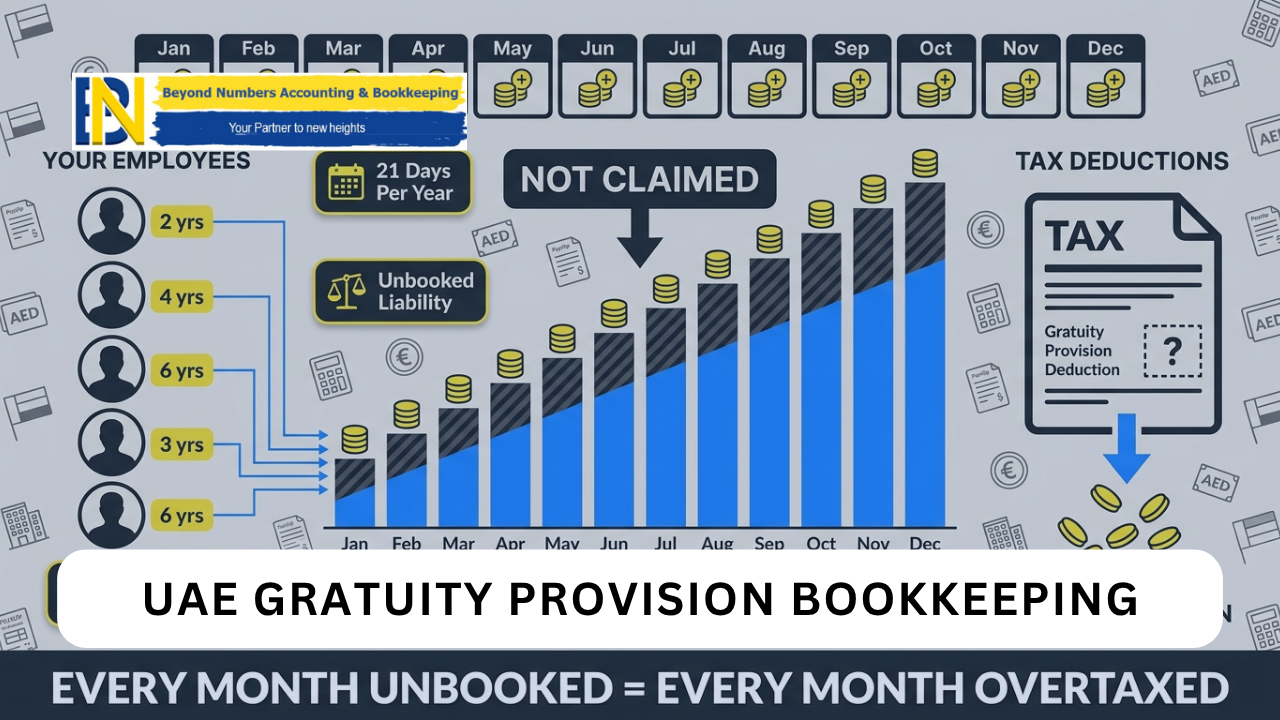
UAE gratuity, or end-of-service benefit, is a statutory payment owed to every employee under Federal Decree-Law No. 33 of 2021. Under IFRS accounting standards, which apply to all UAE businesses subject to corporate tax, the gratuity liability must be recognised on the balance sheet as it accrues every month, not just when an employee leaves. This monthly accrual is a deductible expense for corporate tax purposes. Businesses that do not accrue gratuity monthly are both overstating their taxable profit and understating their real liabilities, two problems that compound every month an employee stays.
Every employee in your UAE company is earning gratuity right now, as you read this.
Not at the end of their contract. Not when they resign. Right now. This month. Today.
For every month a staff member works for your business, a gratuity obligation is growing quietly in the background. It does not appear on your bank statement. It does not come up in your monthly expenses unless someone has set up the accounting correctly. But it is real, it is legally required, and it is building whether your books show it or not.
Most UAE small and mid-sized businesses are not recording this liability as it grows. They think about gratuity when an employee hands in their notice, then scramble to calculate what is owed and find the cash to pay it. By that point, the obligation could have been building for three, four, or five years.
That approach is not just operationally risky. Under UAE corporate tax rules and IFRS accounting standards, it is also wrong. And it is costing businesses a legitimate tax deduction every single year they fail to account for it correctly.
What is UAE Gratuity and How is It Calculated?
UAE end-of-service gratuity is a statutory payment that every private sector employer in the UAE must make to an employee at the end of their employment, regardless of whether the employee resigns, is terminated, or retires. The legal basis is Federal Decree-Law No. 33 of 2021 on the Regulation of Labour Relations. Under the 2021 law, resignation and termination now attract the same gratuity entitlement, removing the previous reduction for employees who resigned.
The calculation is based on basic salary only. Housing, transport, and other allowances are excluded from the gratuity base. The formula is straightforward.
- For each of the first five years of service: the employee earns 21 days of basic salary per year.
- For each year of service beyond five years: the employee earns 30 days of basic salary per year.
- The total gratuity is capped at two full years of basic salary.
To convert this to a monthly provision figure, the formula is: daily rate multiplied by the applicable accrual days, divided by 12.
For an employee earning AED 10,000 in basic salary with less than five years of service, the daily rate is AED 10,000 divided by 30, which equals AED 333. The monthly provision is 21 days divided by 12 months, multiplied by AED 333, giving approximately AED 583 per month accruing for that single employee.
Multiply this across a team of ten employees at various salary levels and service lengths, and the monthly gratuity obligation across a typical UAE SME runs into thousands of dirhams. For a team of twenty or thirty, it can easily exceed AED 50,000 per month in combined accruals.
That is a significant and growing liability that should be visible in the accounts every month, not just when someone hands in their notice.
Why does IFRS Require Monthly Gratuity Provisioning?
Under International Financial Reporting Standards, specifically IAS 19 on Employee Benefits, UAE gratuity qualifies as a defined benefit obligation. This is the accounting standard classification that says the employer, not an external fund and not the employee, bears the obligation to pay a predetermined amount based on the employee’s service and salary.
IAS 19 requires defined benefit obligations to be recognised on the balance sheet as they accumulate. Each month that passes, each month of service an employee completes, increases the legal obligation the company owes. Under IFRS, that increasing obligation must be reflected in the financial statements in the period it arises, not in the period it is eventually paid.
This matters for UAE businesses for two connected reasons:
- First, it is the correct representation of the company’s financial position. A UAE company with ten employees who have each worked for three years has a real liability for gratuity that could total hundreds of thousands of dirhams. If that liability does not appear on the balance sheet, the financial statements are presenting a materially more positive picture of the business than reality justifies. Banks, investors, and acquirers who look at those statements are seeing a business that appears stronger than it actually is.
- Second, and directly relevant to corporate tax, the monthly accrual is the mechanism that creates the deductible expense. Under Article 28 of the UAE Corporate Tax Law, expenses are deductible in the period they are incurred, not necessarily the period they are paid. For gratuity, this means the accrual creates the deduction each year, not the lump-sum payment when the employee eventually leaves.
A business that does not accrue gratuity monthly is not deducting it annually. It is storing up a large lump-sum deduction for a future period, one that the FTA may scrutinise more carefully than a consistent, well-documented annual provision.
The Double Cost of Not Provisioning Correctly
There are two separate costs to a UAE business that does not provision gratuity monthly:
- The first is the tax deduction that disappears. A business with an annual gratuity accrual of AED 200,000 that should be deducting this amount each year is instead carrying the cost invisibly until employees leave. When the payment is eventually made, the deduction arrives all at once, potentially in a year where the business has lower profitability or has already used other deductions. The timing mismatch means the business effectively overpays corporate tax in the years it should be deducting the growing obligation.
- The second is the cash flow shock. When an employee with five years of service on AED 15,000 basic salary leaves, the gratuity owed is approximately AED 52,500. If the business has not set aside provisions, that AED 52,500 must come from current operating cash at a moment the business may not have anticipated. For a business where several long-serving employees leave in the same period, for example during a restructuring or following a management change, the unprovided gratuity liability can become a genuine liquidity problem.
Both of these costs are entirely avoidable with correct monthly provisioning.
A Real-World Example of How This Plays Out
Consider a Dubai-based professional services firm with twelve employees. Average basic salary across the team is AED 12,000. The team has an average tenure of three years. No gratuity provision has ever been entered in the accounts.
The monthly gratuity accrual for this team, calculated using the 21-day formula for employees under five years, is approximately AED 7,000 per month in total. Over three years, the unprovided liability on the balance sheet is approximately AED 252,000.
When the corporate tax return is prepared for the current year, the accountant is unable to support a deduction for the AED 84,000 annual gratuity provision because no provision entry exists in the accounts. The business’s taxable profit is overstated by AED 84,000. At 9% corporate tax, the overpayment is AED 7,560 for that year alone, and the same excess has applied in prior years.
Meanwhile, two senior employees announce they are leaving in the same month. Combined gratuity owed is AED 58,000. The business has no reserved funds. The payment must be found from current operating cash under one month’s notice.
Had the business been provisioning monthly from the start, the AED 252,000 liability would have been visible, the tax deductions would have been claimed annually, and the AED 58,000 payment would have been expected, funded, and not a crisis.
How should UAE Businesses Account for Gratuity Correctly?
The monthly process is simple once it is set up correctly. Here is what correct gratuity provisioning looks like in practice:
- Calculate the monthly accrual for each employee individually. The formula uses each employee’s current basic salary, their service band (under or over five years), and the applicable accrual rate (21 or 30 days per year divided by twelve months). This produces a per-employee monthly figure.
- Post the monthly journal entry. Each month, the total accrual is recorded as a debit to the payroll or employee benefits expense line in the profit and loss account, and a credit to the gratuity provision account on the balance sheet. This builds the liability visibly over time.
- Update the calculation after salary changes. Gratuity is based on final basic salary at the date of leaving, not the salary at the date of accrual. When an employee receives a salary increase, the provision should be recalculated to reflect the updated entitlement across the full service period.
- Update the calculation after five years of service. When an employee crosses the five-year mark, the accrual rate increases from 21 days per year to 30 days per year. The monthly provision for that employee increases from this point forward.
- Process the final payment through WPS. When an employee leaves, the final gratuity settlement must be paid through the Wages Protection System along with any outstanding salary. The balance sheet provision for that employee is then reversed against the cash payment.
Keep documentation for the FTA. Maintain a gratuity schedule that shows each employee’s name, start date, current basic salary, accrual rate, monthly provision, and cumulative balance. This schedule is part of the supporting documentation for the deduction in the corporate tax return and should be available for FTA review.
The Alternative Savings Scheme: What UAE Employers Need to Know
Since October 2023, UAE private sector employers have had the option to enrol employees into the Alternative End-of-Service Benefits Savings Scheme established under Cabinet Resolution No. 96 of 2023. Under this scheme, instead of maintaining an internal balance sheet provision, employers make monthly contributions to an SCA-regulated investment fund at a rate of 5.83% of basic monthly salary for employees with under five years of service, and 8.33% for employees with over five years.
The contribution rates mirror the 21-day and 30-day accrual formula, but the accounting treatment is different. Under the scheme, the monthly contribution is expensed immediately as a cash payment. The growing liability no longer sits on the employer’s balance sheet. The investment risk is transferred to the fund, not the employer.
Employers enrolled in this scheme still receive a full corporate tax deduction for the monthly contributions. The deduction simply arises from the cash payment and the contribution expense rather than from an IFRS provision entry.
The scheme is currently voluntary for most employers, mandatory in DIFC through the DEWS arrangement. Employers considering the switch should weigh the balance sheet simplification benefit against the requirement to fund contributions in cash each month rather than carrying a provision.
6-Question Gratuity Provisioning Check for UAE Businesses
Work through this to assess whether your business is handling gratuity correctly right now:
- Does your accounting system include a monthly journal entry for gratuity accrual for every employee on your payroll?
- Is the provision calculated using each employee’s current basic salary and the correct accrual rate for their service band?
- Does the cumulative gratuity provision balance on your balance sheet reflect the actual liability your business would owe if every employee left today?
- Have you recalculated each employee’s accrual after any salary increase?
- Does your corporate tax return include the annual gratuity provision as a deductible expense?
- Do you maintain a gratuity schedule per employee that could be produced for an FTA review?
A no or not sure to any of these is a signal to address the position before the next tax return is filed.
Frequently Asked Questions
Q. Can a UAE business deduct gratuity only when it is paid, not when it accrues?
A. Generally no, for businesses using IFRS accrual accounting, which applies to the vast majority of UAE businesses subject to corporate tax. The deduction arises as the liability is incurred, not when it is paid. Businesses using the cash basis of accounting, which is available only to smaller businesses meeting specific conditions, deduct gratuity when it is paid.
Q. What if a business has never provisioned gratuity and has multiple employees with several years of service?
A. The backlog provision can be calculated and entered in the current period. Depending on the materiality of the amount and the accounting periods involved, a tax advisor should be consulted about the correct treatment across prior periods and the current year.
Q. Does the gratuity calculation change if an employee is on a fixed-term contract?
A. No. The calculation method is the same under Federal Decree-Law No. 33 of 2021 regardless of contract type. Both fixed-term and unlimited-term employees earn gratuity on the same 21-day and 30-day formula.
Q. Is gratuity owed to an employee who is dismissed for serious misconduct?
A. Under Article 44 of Federal Decree-Law No. 33 of 2021, an employee dismissed for certain specified forms of serious misconduct may lose their gratuity entitlement. These are specific, enumerated grounds and do not cover general poor performance or minor disciplinary issues. Legal advice is recommended before withholding gratuity on misconduct grounds.
Q. Does the gratuity provision affect a business’s ability to distribute dividends?
A. The provision itself does not restrict dividends under UAE law, but accurate IFRS financial statements showing the true liability give shareholders a more accurate picture of distributable reserves, which is relevant when considering the sustainability of dividend payments.
You do not Have to Manage This Alone
Setting up and maintaining correct monthly gratuity provisioning is one of those bookkeeping tasks that looks simple once it is running but takes real care to set up correctly, especially for a business with employees at different salary levels, service lengths, and accrual rates.
That is exactly where Beyond Numbers comes in.
Beyond Numbers helps UAE businesses calculate the correct monthly gratuity provision for every employee, set up the accounting entries that build the liability on the balance sheet correctly each month, ensure the annual deduction is properly supported in the corporate tax return, and maintain the per-employee schedule that demonstrates the calculation to the FTA if it asks. For businesses with a historic backlog, the team calculates the catch-up position and advises on the correct way to bring the books up to date.
If your business has never provisioned gratuity monthly or is not sure whether the current provision is accurate, the right time to fix it is before the next corporate tax return is due.
Talk to Beyond Numbers today. Our team will review your current gratuity position, calculate any backlog, set up the correct monthly process, and make sure you are claiming every tax deduction your business is entitled to.
This article reflects UAE Labour Law and Corporate Tax rules as of mid-2026 and is for general guidance only. For advice specific to your business, speak with the Beyond Numbers team directly.