
Quick Answer
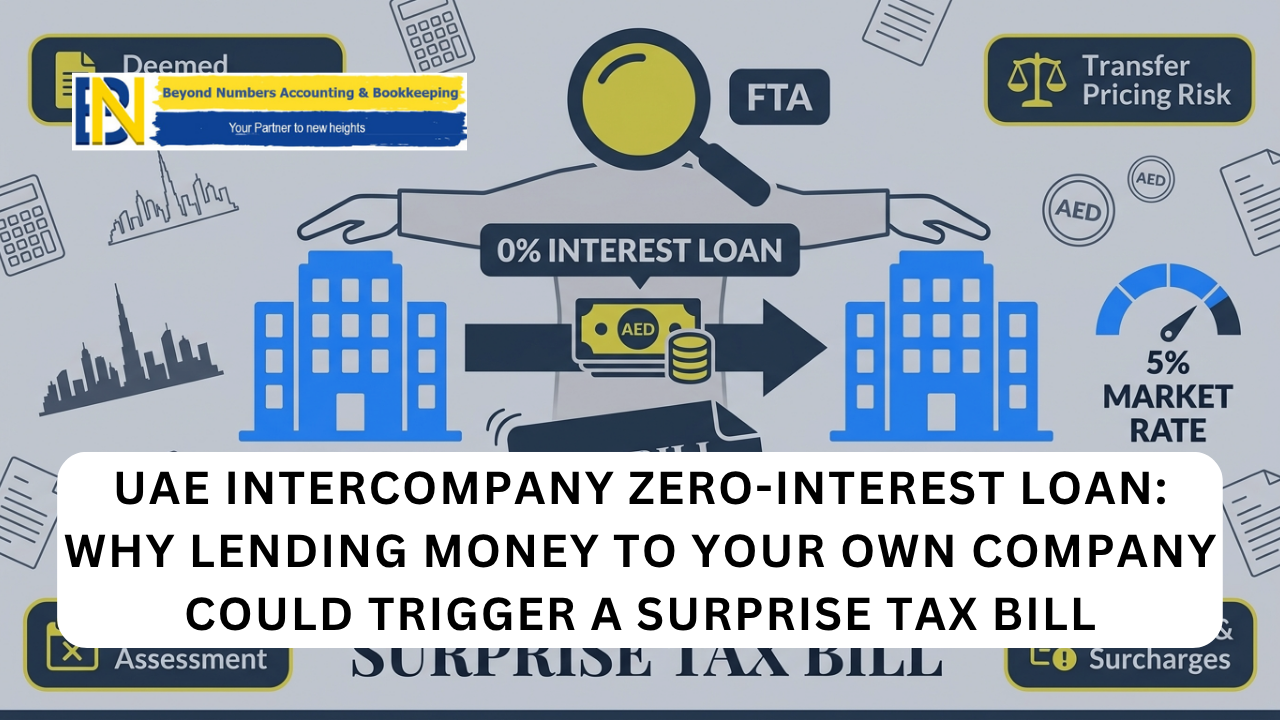
Under UAE Corporate Tax Law, a loan between two related companies at zero interest, or at a rate below market value, is a related party transaction subject to the arm’s length principle. If the FTA determines the loan should have carried a market rate of interest, it can impute that interest as income in the hands of the lending company, increasing its taxable profit even though no interest was ever actually charged or received. The borrowing company may also lose the corresponding deduction if the arrangement is not properly documented.
Here is a situation that happens inside UAE business groups every week.
Company A, owned by the same founder as Company B, has some extra cash sitting in its account. Company B needs money to cover a gap in its cash flow, maybe a big supplier payment or a fit-out cost that came in earlier than expected.
The founder does the sensible thing. Company A transfers the money to Company B. No paperwork. No interest charged. It is all in the family, after all. The plan is to pay it back whenever Company B has the funds available.
This is one of the most common intercompany transactions in UAE business groups. It is also one of the most quietly dangerous ones under the corporate tax rules that took full effect in 2026.
Because from the FTA’s perspective, that zero-interest transfer is not just a cash movement between two companies. It is a financial transaction between related parties that should have been priced the same way an unrelated bank would price it.
And if it wasn’t, the FTA can add income to Company A’s tax return that Company A never actually earned.
What is the UAE Intercompany Zero-interest Loan Rule?
Under the UAE Corporate Tax Law, all transactions between related parties must follow the arm’s length principle. This means every transaction, including financing arrangements, must be priced as if the two parties involved were completely unrelated and negotiating in their own separate interests.
A loan between two unrelated companies always carries an interest rate. An unrelated bank would charge interest. An unrelated investor lending money would charge interest. The rate might vary, but the principle does not: money lent between independent parties always has a cost.
When two related companies transact at zero interest, or at a rate that is clearly below what the market would charge, the FTA treats this as a pricing that would not occur between independent parties. Under the transfer pricing framework aligned with OECD guidelines, the FTA has the authority to adjust the taxable income of both companies to reflect what the transaction would have looked like had it been priced correctly.
For the lending company, this means the FTA can impute interest income. In other words, the FTA can treat Company A as if it had earned interest on the loan, even though it never charged or received a single dirham of interest. That imputed interest becomes part of Company A’s taxable income and is taxed at 9%.
For the borrowing company, the situation also creates risk. If the loan terms are not properly documented, the borrowing company may not be able to deduct interest even in a situation where it genuinely pays it, because the deduction requires a properly structured, arm’s length arrangement backed by documentation.
Why does This Catch So Many UAE Family Businesses Off Guard?
The UAE has historically had no corporate tax, which means there was never any reason for family-owned business groups to price money movements between their own companies at market rates. Cash moved where it was needed. The concept of charging your own sister company interest was not just uncommon, it felt unnecessary and slightly strange.
That logic worked perfectly well before corporate tax. It creates a real compliance problem now.
Under the current rules, the FTA does not look at the intent behind the transaction or the relationship between the owners. It looks at whether the transaction was priced in a way that reflects what two independent parties would have agreed. An interest-free loan between related companies fails that test unless specific conditions are met, primarily that the loan is documented, short-term, and genuinely not the kind of arrangement that would carry interest in a commercial context.
Family business groups are especially exposed because their intercompany transactions often have no formal structure at all. No loan agreement. No repayment schedule. No interest rate, even a nominal one. No board approval. Just a bank transfer and a mental note to sort it out later. That is the exact pattern that draws FTA scrutiny.
What does the FTA Look for and How does the Adjustment Work?
The FTA’s review of intercompany financing focuses on three things.
First, whether a formal loan agreement exists between the two companies. An intercompany transfer with no agreement is treated as a loan by default, which means the arm’s length principle applies whether or not the parties intended it to.
Second, whether the interest rate, if any, reflects what an independent lender would charge for a comparable loan. The comparable rate takes into account the loan amount, the term, the creditworthiness of the borrowing company, the currency, and the purpose of the financing.
Third, whether the documentation supports the commercial rationale. Why did Company A lend money to Company B? Was there a genuine business reason? Are there board minutes or written approvals? Is there a repayment schedule? Is the loan being repaid, or has it simply been sitting on the balance sheet indefinitely?
When the FTA finds a zero-interest or below-market loan with inadequate documentation, the standard adjustment works like this. The FTA identifies an appropriate market interest rate for the loan, typically based on comparable bank lending rates or interbank reference rates adjusted for the borrower’s risk profile. It then calculates the interest that should have been charged over the loan period. That calculated interest is added to the lending company’s taxable income as if it had been received. The lending company pays 9% on income it never actually earned.
To make this concrete: if Company A lent AED 2 million to Company B for twelve months with no interest, and the FTA determines that a comparable arm’s length rate would have been 6% per annum, the FTA could impute AED 120,000 of interest income to Company A. At 9%, that generates a tax liability of AED 10,800, on money that never changed hands.
Across multiple tax years and larger loan amounts, the numbers scale quickly.
A Real-world Example of How This Plays Out
Consider a UAE group with two entities: a mainland trading company and a free zone logistics company, both owned by the same family. In early 2024, the trading company transferred AED 5 million to the logistics company to fund a warehouse expansion. No loan agreement was signed. No interest was charged. The amount appeared as an intercompany receivable on the trading company’s balance sheet.
When the trading company filed its first corporate tax return, the intercompany balance was disclosed in the Related Party Disclosure Form as required. The FTA’s review noted the AED 5 million balance had been outstanding for over eighteen months with no formal agreement and no interest.
The FTA applied a benchmark rate of 5.5% per annum, consistent with comparable secured financing available in the UAE market for that period. It imputed AED 275,000 of interest income to the trading company across the two years the balance was outstanding. The trading company’s taxable income increased by AED 275,000. The additional tax owed at 9% on that amount came to AED 24,750.
The family had not tried to avoid tax. They had simply moved money the way family businesses have always moved money in the UAE. The rules had changed, and nobody had told them.
How Can a UAE Business Group Protect Itself?
The good news is that this is one of the most straightforward compliance risks to address once a business understands it exists. The fix does not require complex restructuring. It requires documentation and pricing.
Put every intercompany loan in writing before the transfer happens. A simple intercompany loan agreement covering the amount, the term, the purpose, the repayment schedule, and the interest rate is the foundation of a defensible position. It does not need to be a lengthy legal document, but it does need to exist and be signed before the transfer, not reconstructed months later.
Price the loan at a market rate. Research what a UAE bank would currently charge for a comparable loan to a business with a similar profile. Use that rate, or something close to it, as the intercompany rate. Keep a brief written note explaining how the rate was arrived at.
Charge and pay the interest. A loan agreement that sets an interest rate but where no interest is ever actually paid creates its own documentation problem. The interest should be charged on the due dates specified in the agreement and actually paid or properly accrued in both companies’ accounts.
Disclose related party transactions correctly. Every UAE corporate tax return requires a Related Party Disclosure Form. All intercompany loans must be disclosed, including the amount, the nature of the relationship, and the pricing. An undisclosed intercompany balance is a separate compliance issue on top of any transfer pricing exposure.
Review existing balances now. If intercompany loans are already sitting on your group’s balance sheet without formal agreements or interest, the right time to address them is before the next tax return is filed, not after an FTA review begins.
7-Question Check for Business Groups with Intercompany Loans
Run through this before your next corporate tax filing if your group has any cash movements between related entities.
- Does a written loan agreement exist for every intercompany transfer currently on the balance sheet?
- Does each agreement specify the loan amount, term, repayment schedule, and interest rate?
- Is the interest rate comparable to what an unrelated lender would charge for a similar loan in the UAE market?
- Is interest being actually charged, paid, or accrued in accordance with the agreement terms?
- Are all intercompany loans disclosed in the Related Party Disclosure Form for the relevant tax period?
- Is there a documented business rationale for why the lending entity provided the loan to the borrowing entity?
- Have any long-standing intercompany balances with no formal structure been reviewed and formalized?
Two or more uncertain answers are a signal to address the position before the next return is due.
Frequently Asked Questions
Q. Does this rule apply to short-term cash movements between related companies, not just long-term loans?
A. Yes. The arm’s length principle applies to any financing arrangement between related parties, including short-term balances. The FTA assesses whether a market rate would have applied, and very short-term advances with genuine business justification may be treated differently, but there is no automatic exemption based on duration alone.
Q. What if both companies are owned by the same person and both are paying tax at 9%? Does the imputed interest matter?
A. Yes. Even where both entities are subject to the same tax rate, the adjustment can still affect the timing and amount of taxable income recognized in each entity in each tax period. It also affects the accuracy of each company’s financial statements and transfer pricing disclosures.
Q. Is the AED 40 million Related Party Disclosure Form threshold relevant to intercompany loans?
A. The Related Party Disclosure Form must be filed by all businesses with related party transactions, regardless of the AED 40 million threshold. The threshold determines whether a more detailed Master File and Local File are required, not whether disclosure is needed at all.
Q. Does the rule apply to loans between a UAE company and a foreign related party?
A. Yes, and the documentation requirements for cross-border related party financing arrangements are generally more detailed than for domestic ones, because both countries’ tax authorities may have an interest in how the transaction is priced.
Q. Can a zero-interest loan ever be acceptable between related parties?
A. In limited circumstances, yes. Certain short-term, incidental advances where both the substance and documentation demonstrate that a market rate genuinely would not apply may be acceptable. These are narrow exceptions, not a general permission to lend interest-free. Specific advice is strongly recommended before relying on this position.
You do Not Have to Figure This Out Alone
Most UAE family business owners who move cash between their own companies have never thought of it as a tax risk. It feels like a purely internal matter. Under the corporate tax rules that are now fully in force, it is not.
That is exactly where Beyond Numbers comes in.
Beyond Numbers helps UAE business groups review all existing intercompany balances, identify any that lack proper documentation or market-rate pricing, prepare intercompany loan agreements that meet FTA expectations, and calculate and disclose related party transactions correctly on the corporate tax return. The team also helps groups establish simple intercompany policies going forward, so every future cash movement between related entities is structured correctly from the start.
If your group has intercompany loans sitting on its balance sheet right now without written agreements or interest, the right time to address them is before your next corporate tax return, not after an FTA query arrives.
Talk to Beyond Numbers today. Our team will review your intercompany position, fix what needs fixing, and help your group file with confidence.
This article reflects UAE Corporate Tax rules as of mid-2026 and is for general guidance only. For advice specific to your business, speak with the Beyond Numbers tax team directly.