
Quick Answer
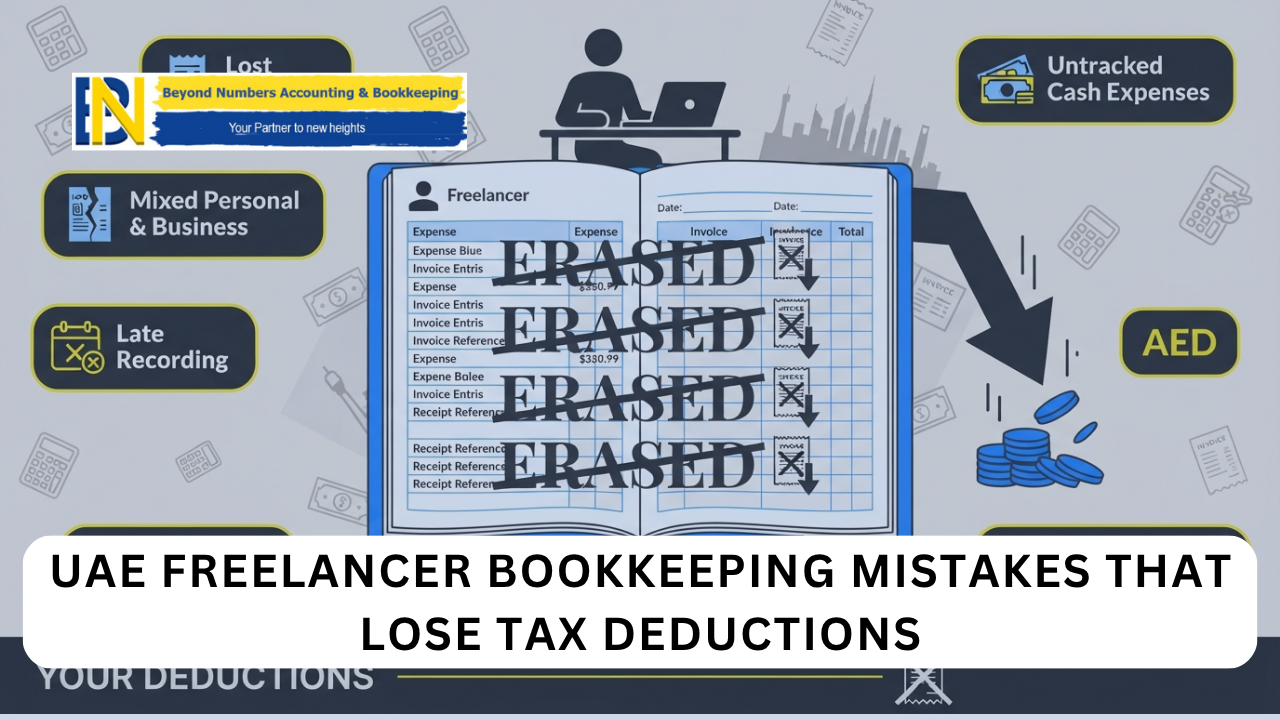
UAE freelancers and sole proprietors registered for corporate tax can deduct legitimate business expenses to reduce their taxable profit. However, the FTA will only accept deductions that are supported by proper records: invoices, receipts, bank statements, and documentation that proves the expense was genuinely for business purposes. Poor bookkeeping does not just make filing harder. It causes legitimate deductions to be rejected, which increases taxable income and the corporate tax bill even when the underlying expenses were completely valid.
You did everything right.
You registered for corporate tax when your business income crossed AED 1 million. You kept your freelance licence up to date. You paid all your invoices on time. You even put aside money for tax because you knew it was coming.
Then your accountant sat down with your records and asked a question that stopped you cold.
“Do you have receipts for these expenses?”
Not all of them. Some you paid in cash. Some you paid from your personal account because it was easier at the time. Some you remember spending but cannot find the invoice for.
Three months of legitimate business expenses. Gone. Not recoverable. Not deductible.
That is the UAE freelancer bookkeeping problem nobody talks about. Not whether you registered correctly. Not whether you understand the tax rates. The boring, practical question of whether you kept the right records, in the right way, so the deductions you are entitled to actually count.
What Deductions Can a UAE Freelancer Actually Claim?
Before getting to what goes wrong, it helps to be clear on what goes right. A UAE freelancer or sole proprietor subject to corporate tax pays tax on net taxable profit, not on total income. That means the business can subtract legitimate business expenses before calculating what is owed.
Common deductible expenses for UAE freelancers include professional tools, software subscriptions, and equipment directly used in the work. Rent for a dedicated workspace or a proportion of home office costs attributable to the business. Business-related travel, transportation, and accommodation. Marketing costs, website hosting, and professional fees. Membership fees for professional bodies directly related to the work. Mobile phone and internet costs to the extent they are used for business purposes.
None of these deductions are complicated in principle. What makes them complicated in practice is the record-keeping requirement that applies to every single one.
Under UAE Corporate Tax Law and the Tax Procedures Law, every expense claimed as a deduction must be supported by adequate documentation that proves the expense was real, that it was for business purposes, and that the amount matches what is being claimed. Without that documentation, the FTA can disallow the deduction entirely, regardless of whether the expense genuinely happened.
Mistake 1: Paying Business Expenses from a Personal Bank Account
This is the most common and most damaging bookkeeping mistake UAE freelancers make. When a business expense is paid from a personal account, it creates an immediate documentation problem: the bank record shows a personal account holder making a payment, not a business making a business expense.
The FTA does not automatically disallow personal account payments, but it does require clear evidence that the payment was for a genuine business purpose. In practice, if a freelancer’s business expenses and personal expenses are mixed in the same account, separating and proving the business ones becomes extremely difficult, especially for payments made months earlier.
The fix is straightforward: a dedicated business bank account used exclusively for business income and expenses. Every payment from that account is traceable. Every receipt associated with a payment from that account connects cleanly to the business record. The account itself becomes part of the audit trail.
Mistake 2: Losing or Not Keeping Receipts for Cash Payments
Many freelancers make legitimate business purchases in cash, especially for smaller items. A receipt from a stationery shop. A taxi fare for a client meeting. A printed marketing material order. These are real business expenses, but without a receipt, they are invisible to the FTA.
Cash payments are not automatically non-deductible. But they do require stronger documentation to support them, because there is no bank record to fall back on. If the receipt does not exist, the deduction does not exist.
The simplest solution is a physical or digital envelope for receipts, updated immediately after every cash purchase. A photo on a phone works. A scan works. What does not work is trying to reconstruct three months of cash expenses from memory at year-end.
Mistake 3: Claiming Mixed-use Expenses Without Documentation of the Business Proportion
A mobile phone used partly for work and partly personally. A laptop bought for both client projects and personal use. A home internet connection used for everything. These are common for freelancers, and they are legitimately partially deductible. The key word is partially.
The FTA expects the business to be able to show what proportion of a mixed-use expense relates to business activities, and to have a reasonable basis for that proportion. Claiming 100% of a phone bill as a business expense when the phone is clearly used personally too is the kind of claim that attracts scrutiny. Claiming a documented 60% because the freelancer can show 60% of usage relates to client work is far more defensible.
The documentation does not need to be elaborate. A simple log showing how the phone or equipment is used, updated regularly, is enough to support a reasonable apportionment claim.
Mistake 4: Not Separating Personal Living Costs from Business Expenses
This one is especially common for freelancers who work from home or who have a lifestyle closely tied to their work. A business dinner that was also a personal meal. A hotel stay that combined a client meeting with a family trip. Clothing bought partly for a professional presentation.
The FTA’s test for deductibility is whether the expense was incurred wholly and exclusively for business purposes. Expenses that mix personal and business elements can be partially deductible if the business portion is clearly documented, but they cannot be claimed in full without evidence that the personal element was genuinely absent or negligible.
Keeping a brief note at the time of each expense explaining the business purpose, who was involved, and what the expense was for takes seconds and creates a record that is very difficult for the FTA to challenge later.
Mistake 5: Not Retaining Records for the Required Period
UAE tax law requires business records to be kept for a minimum of seven years. This includes invoices, receipts, bank statements, contracts, and any other documentation that supports the numbers in a tax return.
Many freelancers store records informally: a folder on a desktop, a stack of papers in a drawer, email threads scattered across multiple accounts. This works until a hard drive fails, a laptop is replaced, or a folder is accidentally deleted. At that point, years of supporting documentation can disappear.
The seven-year retention requirement is not a suggestion. Failing to produce records the FTA requests during a review can result in penalties independent of any tax owed, starting at AED 10,000 for a first offence and rising for repeat violations.
A simple, consistently used cloud storage system, organized by year and expense type, is the minimum any freelancer should have. Back up the backup.
Mistake 6: Waiting Until Tax Filing Time to Organize Records
This is the mistake that turns all the others into a crisis. When bookkeeping is left until the end of the year, or until the filing deadline is approaching, months of transactions need to be reconstructed from memory and scattered documents under time pressure. Expenses get missed. Receipts cannot be found. Mixed-use proportions cannot be documented because the usage happened too long ago to recall accurately.
The result is not just stress. It is a smaller deduction total than the business is legitimately entitled to, which means a higher tax bill than necessary.
Monthly bookkeeping, even a simple one-hour review of income and expenses at the end of each month, eliminates this problem. Records are up to date. Receipts are filed while the expense is still recent. Mixed-use proportions can be estimated and documented while the usage is still visible.
Your 6-Point Freelancer Bookkeeping Checklist
Use this to assess whether your current record-keeping would hold up if the FTA asked questions today.
- Are all business expenses paid from a dedicated business bank account, separate from personal spending?
- Do you have a receipt or invoice for every business expense, including cash purchases?
- For mixed-use expenses, do you have a documented basis for the business proportion you are claiming?
- Have you noted the business purpose of each significant expense at the time it was incurred?
- Are all records stored securely in a system that will still be accessible seven years from now?
- Are you reviewing and updating your records at least monthly, not just at year-end?
A yes to all six means deductions are defensible. Any no is worth fixing now, before the next tax return is due.
Frequently Asked Questions
Q. Does a UAE freelancer need to keep records even if total income is below AED 1 million?
A. Yes. Any individual conducting a business or business activity in the UAE is subject to record-keeping obligations under the Tax Procedures Law, regardless of whether the income threshold for corporate tax registration has been reached.
Q. Can a freelancer claim rent for a home office as a deduction?
A. A proportion of home rent attributable to a dedicated workspace used exclusively for business can potentially be deductible. The proportion must be reasonable and documented. Claiming the full rent when only part of the home is used for work is not supportable.
Q. What happens if a deduction is disallowed during an FTA review?
A. The disallowed amount is added back to taxable income for the relevant period. This increases the corporate tax owed for that period, along with any associated late payment penalties if the tax was already filed and paid on the lower figure.
Q. Is accounting software required, or can records be kept manually?
A. There is no legal requirement for specific accounting software. However, digital records that are consistently maintained and easily searchable are far more practical for producing documentation during an FTA review. Manual records are acceptable if they are complete, organized, and retained for the required period.
Q. Does the AED 375,000 zero-rate band help freelancers with smaller incomes?
A. Yes. Corporate tax is only owed on taxable profit above AED 375,000. Below that threshold, the rate is 0%. Proper deductions that bring taxable profit below AED 375,000 could eliminate the corporate tax liability entirely, which makes accurate record-keeping even more valuable for freelancers in the AED 1 to 2 million revenue range.
You do Not have to Figure This Out Alone
Most UAE freelancers did not become self-employed because they love bookkeeping. They became self-employed to do the work they are good at. Tax record-keeping is a separate skill set, and doing it wrong quietly costs money that most freelancers do not realize they are losing.
That is exactly where Beyond Numbers comes in.
Beyond Numbers helps UAE freelancers and sole proprietors set up simple, sustainable bookkeeping systems that capture every legitimate deduction throughout the year, not just at filing time. The team reviews current records, identifies what is recoverable and what is missing, and prepares corporate tax returns that claim every dirham the business is entitled to.
If you are not confident that your current bookkeeping would pass an FTA review, the right time to fix it is now, before the next filing deadline, not after a query arrives.
Talk to Beyond Numbers today. Our team will review your records, tighten up your system, and make sure your deductions are fully supported and your tax bill is no higher than it needs to be.
This article reflects UAE Corporate Tax rules as of mid-2026 and is for general guidance only. For advice specific to your business, speak with the Beyond Numbers tax team directly.