
Quick Answer
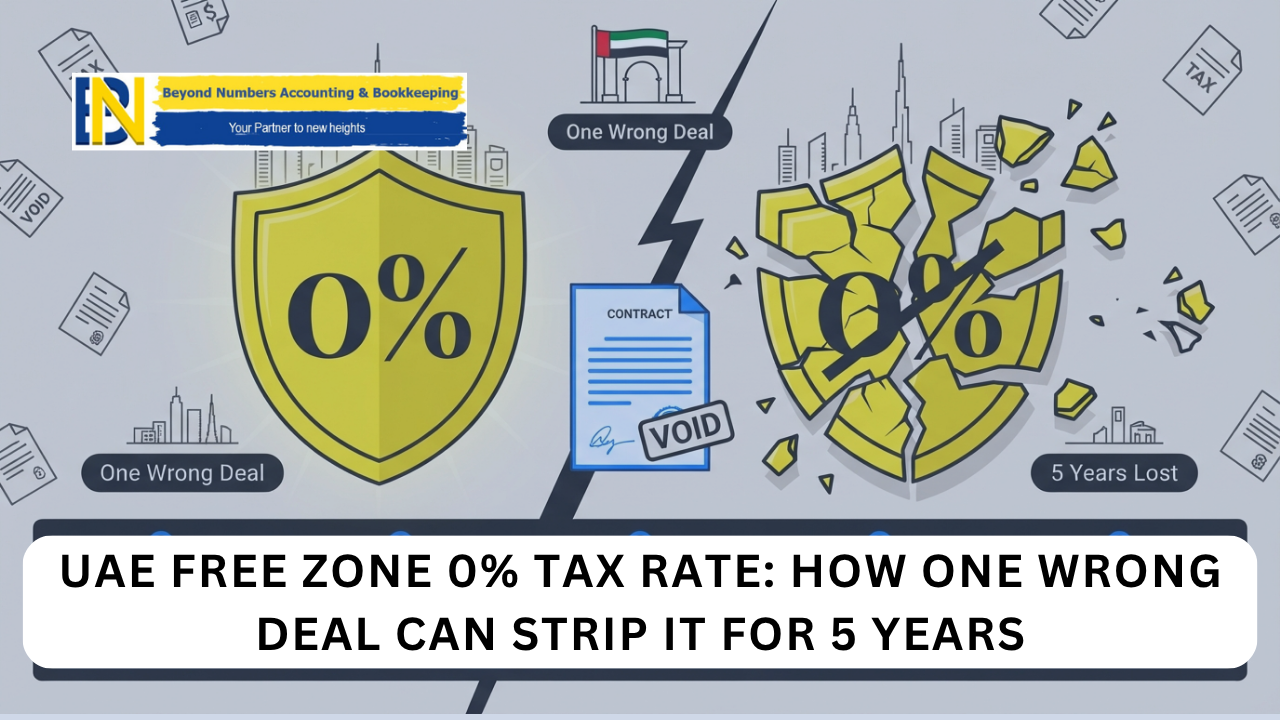
A UAE free zone company qualifies for a 0% corporate tax rate only if it maintains Qualifying Free Zone Person (QFZP) status. One of the conditions is that non-qualifying income must not exceed the lower of AED 5 million or 5% of total revenue in any tax year. Exceeding this limit — even by one dirham — causes the company to lose QFZP status for that full year and the following four years. During that five-year period, all income, including income that would normally qualify for 0%, is taxed at the standard 9% rate.
You opened a company in a UAE free zone for good reasons. Low setup costs. A clean business address. And the one that gets mentioned the most: no corporate tax.
Except that last part is not quite true anymore, and many free zone business owners have not fully caught up with what changed.
Your free zone licence does not give you a 0% tax rate. Your licence gives you the right to try to qualify for a 0% tax rate. Every single year. Under a specific set of rules. With one very dangerous trip wire buried in the middle of those rules.
That trip wire is called the de minimis rule. And it is quietly the most expensive mistake a free zone business can make in the UAE right now.
Here is what it means, why it catches people off guard, and how to make sure your business does not trigger it.
What is the UAE Free Zone 0% Tax Rate Actually Based On?
The UAE free zone 0% corporate tax rate applies only to businesses that qualify as a Qualifying Free Zone Person, or QFZP. A QFZP is not a category you belong to automatically because of where your company is registered. It is a status you earn each year by meeting a set of conditions, and lose the moment you fail any one of them.
Those conditions include having adequate economic substance in the free zone, earning income from qualifying activities, meeting transfer pricing requirements, and preparing audited financial statements each year. Miss any single condition and the company is taxed at 9% on all its income for that tax period, not just the income from the activity that caused the problem.
The de minimis rule is the condition that catches the most businesses off guard, because it is not about what the company does. It is about how much of the wrong kind of income the company accidentally earns.
What is the De Minimis Rule and Why is It So Dangerous?
The de minimis rule sets a limit on how much non-qualifying income a QFZP can earn without losing its 0% status. Non-qualifying income is broadly income from excluded activities, or income earned from customers who are natural persons on the UAE mainland, or income from activities that fall outside the approved qualifying activities list.
The limit is the lower of AED 5 million or 5% of total revenue.
That sounds manageable. But notice the word ‘lower’. For most small and mid-sized free zone businesses, the 5% test kicks in first.
A company with AED 4 million in total revenue can earn no more than AED 200,000 in non-qualifying income before it breaches de minimis. A company with AED 10 million in revenue has a ceiling of AED 500,000.
Now here is the part that makes this rule genuinely dangerous: breaching the limit does not just tax the non-qualifying income at 9%. It removes QFZP status for the entire tax year. Every dirham of income, including all the qualifying income that would normally be at 0%, becomes taxable at 9%. And the same treatment applies for the following four tax years, whether the breach happens again or not.
A Real-world Example That Shows How This Plays Out
Consider a free zone consulting firm in Dubai with total annual revenue of AED 8 million. The company earns most of its income from clients based in other free zones and overseas, which qualifies for the 0% rate.
Halfway through the year, the company takes on a piece of work for a mainland UAE business. The project fee is AED 600,000. This counts as non-qualifying income.
AED 600,000 is 7.5% of AED 8 million in total revenue. The de minimis ceiling for this company is 5%, which equals AED 400,000. The company has exceeded the limit by AED 200,000.
As a result, the company loses QFZP status for the entire year. Corporate tax at 9% now applies to all AED 8 million of income, not just the AED 600,000 from the mainland project. At 9% on the taxable profit above AED 375,000, the company’s tax bill is substantially higher than it would have been if it had simply turned down that one project, or structured the engagement differently from the start.
The same 9% treatment applies automatically for the next four years, even if the company never takes another mainland client again.
What Counts as Non-Qualifying Income?
Not every transaction with a mainland business automatically causes a problem. The rules here are specific, and understanding them is the difference between managing risk carefully and accidentally triggering a breach.
The following types of income are most commonly classified as non-qualifying.
- Income from excluded activities. The list of excluded activities under Ministerial Decision No. 229 of 2025 includes certain financial services, insurance activities, real estate transactions with natural persons, and holding assets for non-business purposes. Income from these activities counts against the de minimis limit regardless of who the client is.
- Income from services provided to UAE mainland natural persons. Selling services directly to individual consumers on the UAE mainland generates non-qualifying income. The more retail-facing a free zone business is, the higher the risk.
- Income from certain mainland businesses for non-qualifying activities. Transactions with UAE mainland companies can qualify in some cases, but only if the activity itself is on the qualifying activities list and specific conditions are met. Assuming all mainland business-to-business income qualifies is one of the most common and costly mistakes.
What are the Conditions That Must All be Met to Keep QFZP Status?
The de minimis rule is one condition among five. Losing QFZP status requires failing only one. Here is what all five conditions require in plain terms.
- Adequate substance in the free zone. The company must genuinely operate in the free zone, not just hold a licence there. Key decisions must be made there, core activities must happen there, and the business must have real staff and assets in the free zone, not just a mailing address.
- Qualifying income only. The majority of income must come from qualifying activities. The full list of qualifying activities was updated under Ministerial Decision No. 229 of 2025 and includes manufacturing, shipping, fund management, wealth management, holding shares and securities, and providing services to foreign persons, among others.
- Passing the de minimis test. Non-qualifying income must not exceed the lower of AED 5 million or 5% of total revenue.
- Audited IFRS financial statements. All QFZPs must prepare audited financial statements every year, regardless of company size or revenue level. Filing a corporate tax return based on unaudited management accounts is itself a breach of QFZP conditions.
- Transfer pricing compliance. Any transactions with related parties must be priced on arm’s length terms and properly documented.
How can a Free Zone Business Protect Its 0% Status?
The most important thing any free zone business can do is track its income by type, in real time, throughout the year. The de minimis calculation is not something to leave until the end of the year when the accounts are being prepared. By then, it may be too late.
- Tag every revenue transaction from the start. Know immediately whether each new piece of income comes from a qualifying or non-qualifying source.
- Run the de minimis calculation at least quarterly. Check where non-qualifying income stands as a percentage of total revenue every three months, not just at year-end.
- Structure client engagements carefully before signing. If a potential mainland client or excluded activity project would push non-qualifying income close to the 5% limit, assess whether to proceed, restructure, or decline before the work begins.
- Get audited financial statements prepared on time. QFZP status requires audited accounts for every tax year. This is not optional at any revenue level.
- Review the qualifying activities list under Ministerial Decision No. 229 of 2025. The list was updated in 2025 and applies retroactively from June 2023. Some businesses may find that activities they assumed were qualifying are not, or vice versa.
- Do not assume mainland-to-mainland-entity income is automatically safe. Business-to-business transactions with mainland companies can qualify in some cases but require the activity to be on the qualifying activities list and the beneficial recipient conditions to be met. Seek specific advice before treating mainland revenue as qualifying.
6-Question Check for Free Zone Businesses Before Year-end
Run through this before your corporate tax filing.
- Have you calculated what percentage of your total revenue comes from non-qualifying sources this year?
- Is that percentage below 5% of total revenue, and below AED 5 million?
- Has every revenue transaction been tagged as qualifying or non-qualifying throughout the year?
- Are your financial statements being audited by a licensed UAE auditor?
- Does your company have real substance in the free zone, including actual employees and genuine decision-making there?
- Have you reviewed whether your activities are on the current qualifying activities list under Ministerial Decision No. 229 of 2025?
A confident yes to all six points to a defensible QFZP position. Any uncertain answer needs to be resolved before the return is filed, not after.
Frequently Asked Questions
Does losing QFZP status mean paying 9% on just the non-qualifying income?
No. Losing QFZP status means paying 9% on all taxable income for that year, including income that would normally be qualifying. The breach affects the entire return, not just the offending income stream.
Is the five-year disqualification automatic, or can a business apply for reinstatement early?
The five-year disqualification period is automatic under the law. There is no application process for early reinstatement. The business must wait out the period and requalify in year six.
Can a free zone business structure itself to serve both mainland and free zone clients without breaching de minimis?
Yes, with careful planning and separate accounting. Some businesses establish a mainland branch or a separate mainland entity for non-qualifying work while keeping the free zone entity focused on qualifying activities. This requires meticulous accounting to keep the two income streams properly separated.
Does the de minimis rule apply to free zone businesses that elect Small Business Relief instead of QFZP?
No. Small Business Relief and QFZP status are mutually exclusive elections. A business electing Small Business Relief is not claiming QFZP status, so the de minimis rules do not apply for that period. However, Small Business Relief is only available for tax periods ending on or before 31 December 2026.
You do not have to Monitor This Alone
For most free zone business owners, the idea of tracking qualifying versus non-qualifying income by transaction, every month, across every client relationship, while also running a business, is not realistic without proper systems and support.
That is exactly where Beyond Numbers comes in.
Beyond Numbers helps UAE free zone businesses set up income tracking systems that flag non-qualifying revenue in real time, run quarterly de minimis health checks before any breach becomes irreversible, and prepare the audited financial statements that QFZP status requires. The team also reviews your qualifying activities against the updated Ministerial Decision No. 229 of 2025 list to make sure your income classification holds up under FTA scrutiny.
If you have never formally checked whether your current client mix keeps you safely inside the de minimis limit, the cost of finding out now is far smaller than the cost of a five-year tax reclassification.
Talk to Beyond Numbers today. Our team will assess your QFZP position, model your de minimis exposure, and make sure your 0% rate is genuinely earned and genuinely protected.
This article reflects UAE Corporate Tax rules as of mid-2026 and is for general guidance only. For advice specific to your business, speak with the Beyond Numbers tax team directly.