
QUICK ANSWER
Under Federal Decree-Law No. 16 of 2025, UAE businesses can no longer carry forward input VAT credits indefinitely. From 1 January 2026, a strict five-year limit applies. Any input VAT incurred before 1 January 2021 that has not yet been claimed is permanently lost. Additionally, any business that first incurred VAT credits in 2021 has until the end of 2026 to claim them. After that, those credits expire too. There is no extension and no appeal once the deadline passes.
Somewhere in your old accounting records, there might be money sitting quietly that belongs to your business.
Not a lot of money, maybe. Or maybe a significant amount, depending on how your business was set up and what you were spending on in those early years.
It is money you paid as VAT on purchases. Money you were always entitled to claim back. Money that has been quietly rolling forward on your books, unclaimed, because it was easier to deal with later.
Later is now almost gone.
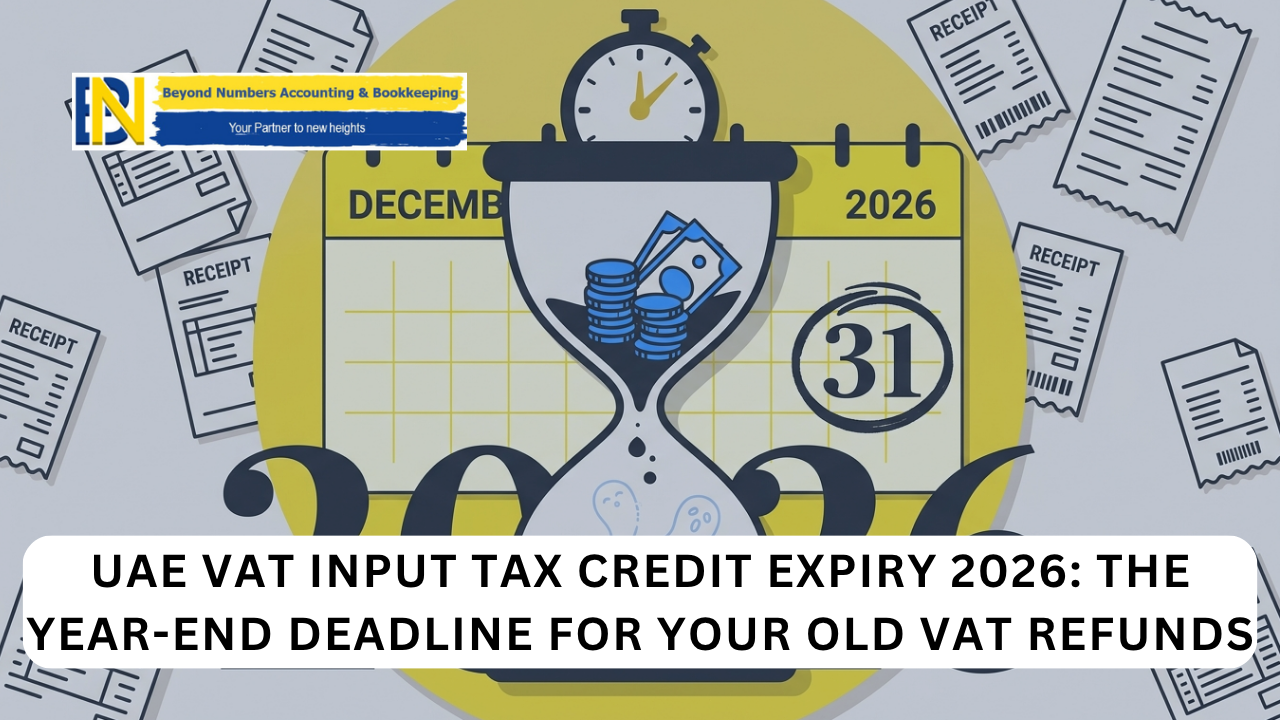
On 31 December 2026, a legal window closes. Any VAT credits your business built up in 2021 will expire permanently if they have not been claimed. Any credits from 2020, 2019, 2018, or earlier are already gone as of 1 January 2026. No extension, no grace period after the deadline, no exceptions for businesses that simply did not know.
If you have never done a proper review of your old VAT credit balances, you are potentially about to lose real money for no reason other than a missed deadline.
WHAT IS THE UAE VAT INPUT TAX CREDIT EXPIRY RULE?
The UAE VAT input tax credit expiry rule is a change introduced under Federal Decree-Law No. 16 of 2025, effective 1 January 2026. It places a five-year time limit on how long a business can carry forward unclaimed input VAT before the credit expires permanently.
Before this change, input VAT credits could theoretically be carried forward indefinitely. A business that built up excess credits during a setup phase, or because it was making mostly zero-rated or exempt supplies for a period, could simply roll those credits forward until it was convenient to claim a refund.
That flexibility is gone. From 1 January 2026, the five-year clock is final. Credits not claimed within five years of the tax period in which they arose are permanently forfeited to the FTA.
A transitional provision does offer a limited opportunity for the very earliest credits. If a business’s five-year window expired before 1 January 2026, or will expire within one year of that date, the business gets a one-time window until 31 December 2026 to submit the refund claim. This transitional provision is not an extension of the five-year rule. It is a one-time rescue window that closes on 31 December 2026 and will not be offered again.
WHY DOES THIS RULE CATCH SO MANY BUSINESSES OFF GUARD?
The honest answer is that many UAE businesses have never thought carefully about the age of their VAT credits.
VAT was introduced in the UAE in January 2018. For the first few years, many businesses, particularly startups, free zone entities, and capital-intensive companies in manufacturing or logistics, spent heavily on equipment, fit-outs, staff, and services. They paid VAT on all of it. In many cases, because they had not yet started generating significant taxable revenue, the input VAT they paid exceeded the output VAT they collected, leaving them with a net credit position.
Rather than going through the process of applying for a VAT refund, many business owners did what seemed sensible at the time: they left the credit sitting on the books and planned to use it to offset future VAT liabilities. It felt like a savings account, money the government owed them, available whenever they needed it.
The 2026 rule change means that account has an expiry date they never knew about. And for some businesses, parts of that balance have already expired.
WHICH BUSINESSES ARE MOST EXPOSED?
Three types of UAE businesses are at the highest risk of being caught by this deadline.
Free zone businesses that delayed refund claims. Free zone companies often accumulate significant input VAT during their setup phase, buying equipment, fitting out offices, and paying for professional services. Many deliberately delayed claiming refunds until they reached a larger balance or until the process felt less complicated. If those credits date to 2020 or earlier, they are already gone. If they date to 2021, the 31 December 2026 deadline applies.
Capital-intensive startups in manufacturing, logistics, and hospitality. Businesses in these sectors typically spend heavily before they start earning. The VAT on early equipment purchases, construction costs, and fit-out expenses can add up to very large credit balances. If those early purchases were made in 2020 or 2021, the deadline is either already passed or fast approaching.
Businesses that made mostly exempt or zero-rated supplies early on. A business making primarily zero-rated exports, for example, could not offset its input VAT against output VAT in the normal way. If those credits were never formally claimed as refunds, they may now be sitting in an account that is about to expire.
A REAL-WORLD EXAMPLE OF HOW THIS PLAYS OUT
Consider a logistics company that launched in the UAE in late 2020. During the setup phase, the company spent heavily on warehouse fit-out, vehicles, and IT systems, all of which included VAT. By the end of 2021, the company had accumulated AED 180,000 in input VAT credits.
At the time, the company’s VAT advisor suggested rolling the credits forward and offsetting them against future VAT liabilities rather than applying for a formal refund. This was common advice and completely valid under the rules at the time.
By 2024, the company had largely offset the credits against ongoing VAT liabilities, but approximately AED 40,000 remained unclaimed, representing purchases made in early 2021. The company never formally applied for a refund because the balance felt small relative to the effort involved.
Under the new 2026 rules, the five-year window for those 2021 credits closes by the end of 2026. If no refund application is submitted before 31 December 2026, the AED 40,000 is permanently lost. The government keeps it. There is no appeal process once the deadline passes.
WHAT SHOULD A UAE BUSINESS DO RIGHT NOW?
The window is still open, but it is closing fast. Here is a simple, step-by-step approach to making sure your business does not lose money it is entitled to.
Step 1: Pull your VAT records going back to 2018. Look at every tax period and note whether a credit balance arose in that period, and when.
Step 2: Identify which credits were from 2021 or earlier. Any credits from 2020 or before that have not been formally claimed are already past the five-year window and are most likely gone. Credits from 2021 face a 31 December 2026 deadline.
Step 3: Calculate how much of those credits was actually used to offset output VAT liabilities in subsequent periods, and how much, if any, remains unclaimed.
Step 4: If an unclaimed credit balance from 2021 exists, start preparing a VAT refund application immediately. Do not leave this until December.
Step 5: Make sure you have the supporting documentation for every credit you are claiming. Under the 2026 rules, the FTA can audit a refund claim even after the limitation period has closed, so the paperwork needs to be solid.
Step 6: Review your record-keeping system to make sure you have a clear, searchable record of which credits have been claimed and which have not, so this situation does not repeat itself.
6-QUESTION CHECK TO SEE IF YOUR BUSINESS IS AT RISK
Run through this today.
1. Has your business ever carried forward a VAT credit balance without formally claiming a refund?
2. Do you know which tax periods those credit balances originated from?
3. Have you identified any credits that originated in 2021 or earlier?
4. Has your business formally applied for a VAT refund for all credits older than four years?
5. Do you have complete supporting documentation for any credits you are still carrying?
6. Does someone in your business have a clear record of which VAT credits have been claimed and which have not?
If the answer to any of questions one through five is “not sure,” a proper review is urgently needed before the end of 2026.
FREQUENTLY ASKED QUESTIONS
What happens if a business misses the 31 December 2026 deadline?\
The credits expire permanently. There is no appeal, no extension, and no mechanism to recover them after the deadline passes. The FTA is clear on this.
Does this rule affect businesses that have always used their credits to offset VAT liabilities?
Only to the extent that any unclaimed credit balance remains. If credits have been fully offset against output VAT, there is nothing to worry about. The risk is specifically for credits that have never been either offset or formally claimed as a refund.
Is the transitional provision a guaranteed extension for all businesses?
No. The transitional provision applies only to credits whose five-year window expired before 1 January 2026 or will expire within one year after. It is a one-time rescue window, not a general extension of the rule.
Can a business apply for a VAT refund even if the amount is small?
Yes. There is no minimum threshold for a VAT refund application under the current rules. The administrative effort may not always feel worthwhile for very small balances, but any unclaimed balance is at risk of expiry regardless of its size.
Does this rule apply to free zone businesses?
Yes. The five-year limit on carrying forward input VAT credits applies to all VAT-registered businesses in the UAE, including those operating in free zones.
YOU DO NOT HAVE TO FIGURE THIS OUT ALONE
Going back through years of VAT records to work out whether you are sitting on expiring credits is not something most business owners have time for on top of running a company. It requires knowing exactly which tax periods to look at, how to calculate what has been used versus what remains, and how to prepare a refund application that the FTA will accept without a long back-and-forth.
That is exactly what Beyond Numbers is here for.
Beyond Numbers helps UAE businesses dig into their historical VAT records, identify any credits that are still recoverable before the deadline closes, prepare the correct documentation, and submit a refund application that stands up to FTA scrutiny. The team also reviews your ongoing VAT credit position to make sure you never find yourself in this situation again.
If you are not certain whether your business has old VAT credits at risk of expiry, the cost of not checking could be far higher than the cost of a quick review.
Talk to Beyond Numbers today. Our team will assess your VAT credit history, identify any recoverable amounts, and make sure your business claims back every dirham it is entitled to before the window closes permanently.
This article reflects UAE VAT rules as of mid-2026 and is for general guidance only. For advice specific to your business, speak with the Beyond Numbers tax team directly.