
QUICK ANSWER
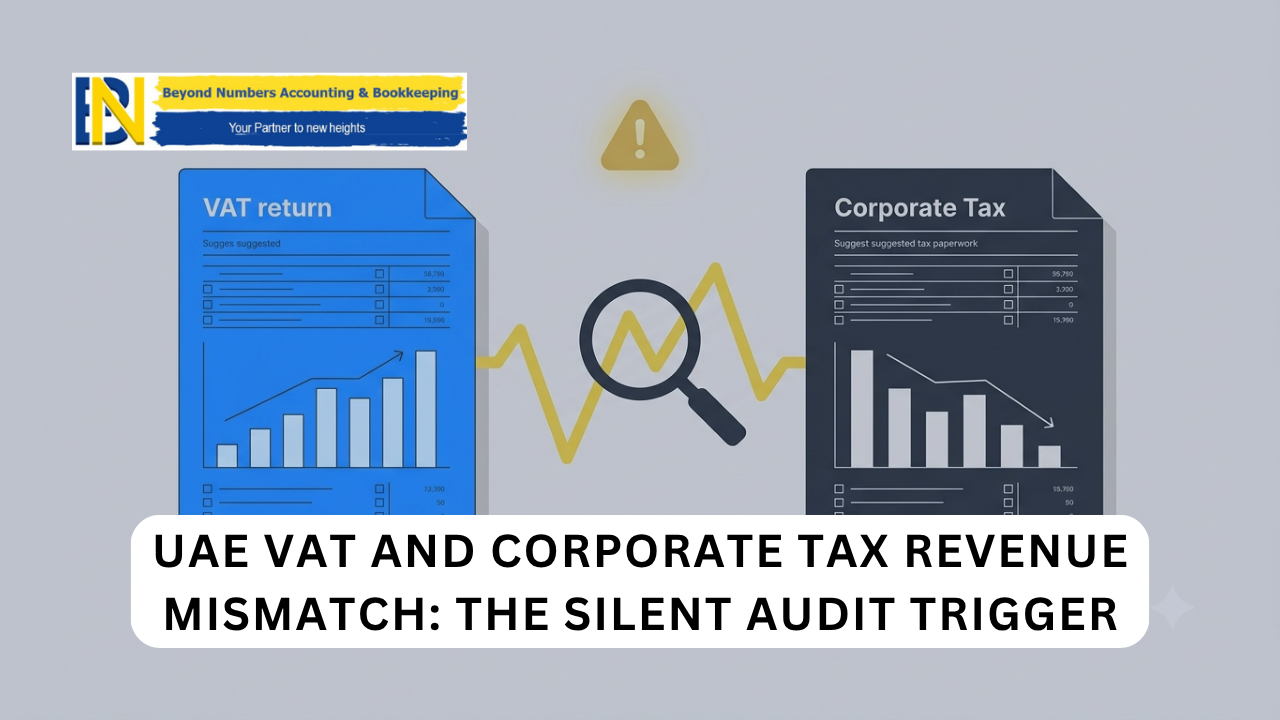
A UAE VAT and corporate tax revenue mismatch occurs when the revenue a business reports on its VAT returns differs from the revenue it reports on its corporate tax return. The FTA’s EmaraTax system automatically compares both filings. If the numbers do not match and the business cannot explain the difference with proper documentation, the FTA treats it as a red flag and may select the business for a full audit covering both taxes across multiple years.
You probably filed your VAT return last quarter without a second thought. You have been doing it for years. It is routine by now.
Then, separately, your accountant put together your corporate tax return. Two different forms. Two different deadlines. Two different sets of numbers.
Here is the thing nobody told you: those two sets of numbers are now being compared against each other automatically, every single time you file.
And if they do not match, a flag goes up inside the FTA’s system. Not a human reviewing your file. An automated system. One that works around the clock and never misses a discrepancy.
This is the UAE VAT and corporate tax revenue mismatch problem. It is quiet, it is technical, and it is catching businesses completely off guard in 2026.
WHAT IS A UAE VAT AND CORPORATE TAX REVENUE MISMATCH?
A UAE VAT and corporate tax revenue mismatch is a gap between the revenue figure a business reports on its periodic VAT returns and the revenue it reports on its annual corporate tax return. Because VAT is filed quarterly (or monthly for larger businesses) and corporate tax is filed annually, most businesses treat the two as completely separate compliance tasks. Many even use different advisors or different teams to handle each one.
The FTA’s EmaraTax platform does not see them as separate. EmaraTax automatically pulls both sets of data together and checks them against each other. If a business reports AED 4.2 million in taxable supplies across its four VAT returns for the year, but its corporate tax return shows AED 3.7 million in revenue for the same period, the system flags a difference of AED 500,000 and marks the business for closer review.
This has been happening since the first corporate tax filing season in 2025. In 2026, with the FTA now firmly in enforcement mode after conducting 93,000 inspection visits in 2024 alone, the consequences of an unresolved mismatch are far more serious than they were even one year ago.
WHY DO MISMATCHES HAPPEN, EVEN IN HONEST BUSINESSES?
This is the part that surprises most business owners. A mismatch does not mean something illegal happened. There are several completely legitimate reasons why VAT revenue and corporate tax revenue can look different. The problem is not the difference itself. The problem is not being able to explain and document it.
Here are the most common reasons a genuine gap appears.
- Timing differences. VAT is generally reported when an invoice is issued. Corporate tax revenue can follow different recognition rules depending on the accounting method used. A sale invoiced in December may show in the VAT return for Q4 but hit the corporate tax return for the following year.
- Exempt and out-of-scope income. Income that is VAT-exempt or outside the scope of VAT entirely, such as dividend income, interest income, or certain government grants, may still count as revenue for corporate tax purposes. It will not appear in the VAT return at all, but it will appear in the corporate tax return.
- Zero-rated exports. Sales that are zero-rated for VAT still appear in the VAT return as taxable supplies at 0%. Depending on how the corporate tax return is prepared, the revenue might be recorded differently, creating an apparent gap.
- Reverse charge transactions. When a UAE business receives services from overseas and applies the reverse charge mechanism, the VAT liability is self-accounted. The treatment of this revenue in VAT versus corporate tax filings can vary and create apparent discrepancies.
- Free zone ring-fencing. Qualifying Free Zone Persons must keep qualifying and non-qualifying income completely separate. If the separation is not clean in the books, the two filings can show different revenue figures for reasons the FTA will want to understand.
None of these situations is fraudulent. But all of them need to be documented clearly before the FTA asks, not scrambled together after a query arrives.
WHAT HAPPENS WHEN THE FTA SPOTS A MISMATCH?
The FTA’s EmaraTax system flags the discrepancy automatically. After that, one of two things typically happens.
For smaller or unexplained mismatches, the FTA may issue a query letter asking for a reconciliation. The business has a defined deadline to respond with a documented explanation. Under Federal Decree-Law No. 17 of 2025, which expanded FTA powers effective January 2026, failure to respond on time or respond adequately now carries stronger consequences than before.
For larger or recurring mismatches, or where a query response is unsatisfactory, the FTA can escalate to a full audit. A full audit does not just look at the year in question. It can cover multiple tax periods for both VAT and corporate tax simultaneously. Under the new penalty framework effective April 2026, errors the FTA finds during an audit carry a 15% penalty on the understated tax amount, plus 14% annual interest on any late payments.
The important thing to understand is that an audit triggered by a mismatch is not limited to the mismatch itself. The FTA audits the whole filing history. A small unexplained gap can open a very large door.
A REAL-WORLD EXAMPLE OF HOW THIS PLAYS OUT
Consider a trading company in Dubai with annual revenue of around AED 5 million. The business files quarterly VAT returns on time every quarter, reporting a total of AED 5.1 million in taxable supplies across the year.
When the corporate tax return is filed, the accountant uses the audited financial statements, which show revenue of AED 4.6 million. The AED 500,000 difference exists because the financial statements exclude certain reimbursements that were included in VAT returns, and because a large Q4 invoice was accrued differently under the accounting policy used.
Both figures are arguably correct under their respective rules. But the business has no written reconciliation that explains the gap. EmaraTax flags the difference. The FTA sends a query. The business now needs to reconstruct months of records under a tight deadline, at real cost in time and professional fees, to explain something that was never actually a problem in the first place.
The reconciliation that should have taken one hour before filing now takes weeks after the query arrives.
HOW CAN A UAE BUSINESS PREVENT THIS?
The fix is simpler than most business owners assume. It does not require new software or a complete overhaul of how the business operates. It requires one habit: reconciling VAT and corporate tax revenue figures before submitting either return, and keeping a simple written record of every difference and why it exists.
Here is a practical approach any business can follow.
- Step 1: Pull the total taxable supplies figure from all VAT returns filed for the year.
- Step 2: Pull the total revenue figure from the draft corporate tax return or the financial statements being used.
- Step 3: List every difference between the two figures, no matter how small.
- Step 4: For each difference, write one or two sentences explaining what caused it. Timing difference, exempt income, zero-rated exports, reverse charge treatment, and so on.
- Step 5: Attach the supporting document that proves the explanation. An invoice, a bank statement, a contract, a board minute.
- Step 6: Keep this reconciliation on file and be ready to produce it within the FTA’s response deadline if a query ever arrives.
That reconciliation document is not a legal requirement on its own. But it is the single most effective thing a business can have ready when the FTA asks a question.
6-QUESTION SELF-CHECK BEFORE YOU FILE YOUR NEXT CORPORATE TAX RETURN
Run through this before submitting any corporate tax return.
1. Have you added up the total revenue reported across all VAT returns for the same period?
2. Does that VAT total match the revenue figure in your corporate tax return?
3. If there is a difference, can you name every single reason for it?
4. Do you have a supporting document for each reason?
5. Has the reconciliation been written down somewhere you can find it quickly?
6. If the FTA sent a query tomorrow, could you respond with a complete, clear explanation within five business days?
A confident yes to all six means the business is in a strong position. Any uncertain answer is worth resolving before the return is filed, not after.
FREQUENTLY ASKED QUESTIONS
Does every business need to worry about this, or only large companies?
Every VAT-registered business that also files corporate tax is exposed. The FTA’s EmaraTax system cross-checks all filings regardless of size. Smaller businesses are often less prepared, which makes the risk higher in practice, not lower.
Is a small mismatch less likely to trigger an audit than a large one?
Not necessarily. The FTA’s system is risk-based, not purely size-based. A pattern of small, unexplained mismatches across multiple periods can attract as much scrutiny as a single large one.
What if the mismatch was caused by a genuine accounting difference, not an error?
Genuine accounting differences are acceptable and common. The issue is whether the business can explain and document the difference. A valid reason that is undocumented is treated the same as no reason at all during an FTA review.
Can a voluntary disclosure help if a mismatch has already been filed?
Yes. Filing a voluntary disclosure before the FTA issues a formal audit notice results in significantly reduced penalties under the 2026 penalty framework. Acting before the FTA asks is always better than reacting after.
YOU DO NOT HAVE TO FIGURE THIS OUT ALONE
Most UAE business owners are managing VAT and corporate tax as two completely separate tasks, handled by different people at different times of year. That approach made sense before EmaraTax started cross-referencing everything automatically. In 2026, it is a risk most businesses cannot afford to carry.
That is exactly where Beyond Numbers comes in.
Beyond Numbers helps UAE businesses reconcile their VAT and corporate tax figures correctly, document every legitimate difference in a clear and defensible way, and build filing habits that hold up if the FTA ever asks questions. The team reviews your existing filings, identifies any gaps that need attention, and makes sure both your VAT and corporate tax returns tell a consistent, well-supported story.
If you are not sure whether your last VAT and corporate tax filings match, the right time to find out is now, before the FTA does it for you.
Talk to Beyond Numbers today. Our team will run a reconciliation check on your filings, explain any gaps, and get your records into a position you can be confident about.
This article reflects UAE VAT and Corporate Tax rules as of mid-2026 and is for general guidance only. For advice specific to your business, speak with the Beyond Numbers tax team directly.